Monday, February 23, 2009

JJNN: LED veggies

Welcome again to JJNN for February 23rd, 2009. Today I will be talking about a new way of growing vegetables.

A farming venture company in Kyoto named Fairy Angle (what a name, huh?) has been experimenting with different ways for growing vegetables. They have been using lights of different colors as different stages of development to make sure the vegetable turns out shaped well and full of nutrients. You can see the original article here.

The company believes that if the vegetables are grown with red light they will undergo a faster form of photosynthesis and thus lead to bigger and more nutritious vegetables. This got me thinking. Could it really be true that different color lights could change the rate of something as natural as photosynthesis? I went and did some poking around the internet and found this article put out by CU Boulder in 2001. The gist of the article is that red light might speed up photosynthesis just a little bit, but that is really lost within the noise of the experiment. In other words, it is not really measurable, which means it might not even exist.

The Kyoto company also says blue light helps the vegetable take its shape. I don't really get this. You never see carrots come out of the ground looking like pumpkins just because they didn't get any blue light. Well, I guess I can't say that because blue light is included in the white light that the vegetables get. Maybe I should do my own experiment with a darkroom, some red lights and carrot seeds.

The article also states that they are using green lights. That made me shake my head. The leaves of the vegetable are green because they are reflecting back all of the green light. If you shine just green light on a plant it would be just the same as keeping the plant in a dark room.

Normally something like this would never get into the news, but this company made a change. They changed from normal colored light bulbs to LED lights. They are being shown as great pioneers that are thinking of the environment while trying to produce new plants. The truth is that the best way to think of the environment is to let the plants grow outside in normal sunlight.

I will leave you a picture of this vegetable factory.

Saturday, February 21, 2009

JJNN: Station Boxed Lunches

Welcome again to JJNN for February 21st, 2009. Today I will be talking about magical boxes filled with delicious food.

The Japanese have a tradition of traveling around and eating the delicious foods in that area. There is even a place only a few hours by train from where I live that is known for it's ramen. So right in the train station is a map of all the ramen shops in the town. You can take the map and go from shop to shop eating different types of ramen. There is another place a little further away that is known for it croquettes. You can walk from shop to shop and try the croquettes with different fillings.

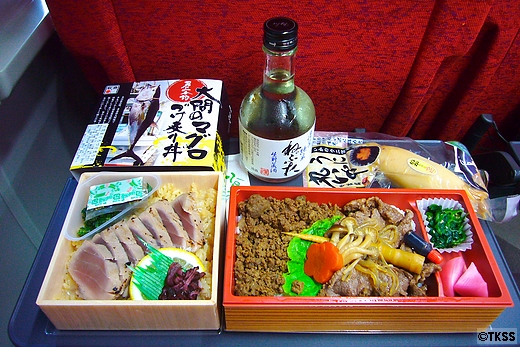
You don't have to go to the different towns to get the different types of food that are famous in an area. There are such things as Station Boxed Lunches (in Japanese they are called eki-ben). They are usually sold inside a train car, but some times you have to get off the train at the area to get the food. I love eki-ben. It is a little expensive, but it is always filling. You can see some pictures of eki-ben below.


They look good, don't they. The top picture shows two eki-ben. They have both fish and meat. They both look very good. The bottom one has meat and lots of different side dishes. These things are making me very hungry. The reason I am talking about eki-ben today is because of this article. The article is about the eki-ben is kyushu (one of the smaller islands in Japan). It sounds out for the second year in a row the eki-ben named kirei-gawa is the number one eki-ben in kyushu.

That is no small feat because the field is 50 different types of bento. Kirei-gawa has lots of mushroom and deep fried potatoes and rice that was cooked with different types of vegetables. It will set you back 1050 yen (around 10USD). Kyushu is a little bit far away so I don't think Iw ill ever eat this eki-ben, but if I am ever in the area I will be sure to try the number one. Yummmm

Thursday, February 19, 2009

JJNN: Random Animations

Welcome again to JJNN for February 19th, 2009. Today I will be having a lazy day.

Every so often I just want to be lazy. I actually have a reason today though. I didn't get back home until after 9 so I have no real time to look for anything good to write about. So, instead of having thoughtful discussion I will show random animations from Japanese artists.

This first one is from a student artist. The person made this animation out of different cloths. In the notes to the film it says the the main fish is a type of sea bream.


The second animation is all about natto. Natto is a Japanese food that is made from (actually is 100 percent) fermented soy beans. Natto is known for being sticky and slippery at the same time. Also when you try to eat it long strings of some sort of stuff (I still don't know what it is) go from one piece of natto to another. It makes it very hard to eat. That and most people don't like the taste or the smell. Any way this video is all about natto and how people (literally) sing its praises.


At the end of that last video the guy says "oishikunai" which means "It doesn't taste good." The last video doesn't have audio, but is good. It is the story of how this guy is trying to get candy that is on the top of a high shelf. Being as short as I am I feel his pain.


Any way, that is the limit to my laziness for today. I hope you all enjoyed and depending on how drunk I get tomorrow I will probably do the same. (By the way I have a reason for getting drunk...I passed the highest level of the Japanese proficiency test so I have to celebrate. Yay!)

Wednesday, February 18, 2009

JJNN: Nano pyramids

Welcome again to JJNN for February 18th, 2009. Today I will be talking about very small pyramids.

There is something cool about tiny things. In this day and age products sell better or news stories are read more if they contain the word "nano". So, what exactly is nano all about? It stands for one billionth of something. It could be anything from a nanosecond to a nanometer. Either way it is a very tiny thing. This is also where we get the term nano-machines. It just means a really really really small machine.

So, according to this article, a Japanese group was able to produce the first pyramids on the nano scale. They came up with an interesting way of making these things. First they make a solution that is made up of silver ions. A near infrared laser is than shown into the solution and the silver solidifies because of laser light. The team is making tiny pyramids that measure 1/500 of a millimeter with this process. The team uses a surfactant to make a the pyramids hollow inside. You can see a picture of these pyramids below.


What make these little pyramids amazing is the fact that they turn out in the shape the researchers want them to turn out in. Constructions that small have been made before, but they always turn out irregular. Now that these things can be produced in a regular way they can be used in integrated circuit technology and on the medical front. It will be interesting to see how these things will be used in the future.

Tuesday, February 17, 2009

JJNN: Maido 1 update

Welcome again to JJNN for February 17th, 2009. Today I will be giving a quick update of Maido 1.

I talked about Maido 1 back on February 12th. This has quickly become my favorite satellite. Well, actually, I guess I don't have a ranking of satellites that I like, but if I did it would be on the top I guess. As I said before, the job of Maido 1 is to gather data about lighting and electric storms.

Well, as it turns out, Maido 1 got it's first real look at lighting over the weekend. In it's orbit Maido 1 caught a glimpse of lighting over Africa and Australia. This detection of lighting was not planned, but it ended up being a good test for the Maido 1's sensors. The person that designed Maido 1's sensors says that the sensors could clearly detect the lighting and everything checked out just fine.

To put a face (?) with the name Maido 1 I included a picture of the satellite below. Enjoy.

Monday, February 16, 2009

JJNN: NEDO

Welcome again to JJNN for February 16th, 2009. Today we will be talking about robots.

I watched a lot of TV as a child. When I was very young my family didn't have cable TV so I was forced to watch the free TV stations. My favorite TV channel was PBS. I spent hours watching such shows as Discovery and NOVA. Every so often one of those TV programs would do a show on robots. They would say how great robots were and how great they would become. I lost track of the times that I hard that all homes in America would have robots in them by 2010. Well, it's early in 2009, but I can't see a golden age of robot help in the home around any corner. Where is my robot!? I want my robot, damn it!

Well that is where this news article and NEDO steps in. What's NEDO, you may ask. Well NEDO stands for New Energy and Industrial Technology Development Organization. Technically I guess it should be NEITDO, but that is not as easy to say. NEDO is an organization that started way back in 1980 because of the oil crisis . Back than it was all about finding an energy source to replace oil. They started to look into industrial technology in 1988. Ever since 2006 they have been holding their robotics contest. The contest for this year is geared towards robots that could be mass produced for 2015 (only 5 years after the 2010 prediction from NOVA)

The NEDO robotics contest hard 3 distinct categories: advancements in the field of industrial robotics, advancements in the field of robots used in medical facilities, and advancements in field of robots used in emergencies. Though there were 18 robots in the running in the three categories, only 6 ended up getting any prize.

There were also demonstrations at the contest. The first robotic demonstration was a robot that goes around a hospital and passes out medicine and other such things. Personally I don't think this would fly in America because that robot would probably be pried open within an hour of it starting to operate. A defenseless robot with narcotics inside of it... not going to work.

The second robot is a rescue robot. It weighs about 20 Kg (about 44 pounds) and can be used to go into places that are too dangerous or tight for humans to enter. The robot sports a fisheye lens camera and infrared camera. A special software uses the information from the cameras to make a 3D map of the area. That is all nice, but in the end this is basically a really mobile radio controlled car that has cameras strapped to it. You can see a picture of the hospital robot (the upper picture) and the rescue robot (the lower picture) below.


Friday, February 13, 2009

JJNN: Kaguya

Welcome again to JJNN for February 13th, 2009. Today we will be talking about yet another Japanese satellite.

Way back on October 27th of last year I talked about a Japanese satellite called kaguya. The last news report was about how kaguya failed to find water on the moon. This news report (found here) is about how kaguya was able to accurately map the surface of the moon.

Kaguya has been flying around the moon for a while now measuring altitude (I sort of want to say distance above sea level, but there is no sea on the moon) of the moon surface. This is the first time in history that a moon topographical map has been made with such great detail. The last moon map was made with about 270,000 data points, but the map that was made with kaguya has 6,770,000 data points. That tells a whole lot about the surface of the moon. You can see the map that was created by kaguya below.


The view below also shows the highest point (circled in black) and the lowest point (circled in white).


So, what can we learn from this map? Well, the distance around the moon at the equator is 1783.64 Km (1108.30 miles) and the distance around the moon from pole to pole is 1735.66 Km (1078.49 miles). These numbers are very close to each other, which means the moon is a near perfect sphere. It also turns out that the difference in height between the highest point on the moon and lowest point on the moon is a mere 19.81 Km (12.31 miles).

Now that kaguya has finished it's job of mapping the moon it really doesn't have anything left to do. It will fall out of orbit and crash on to the moon's surface later this year. I am sort of say to think that it is just going to end up as trash on the surface of the moon, but I guess it gave us a lot for the trade off of a little trash.

Thursday, February 12, 2009

JJNN Maido 1

Welcome again to JJNN for February 12th, 2009. Today we will be talking about a satellite.

As I talked about on January 23rd there was a a lot of satellites were put into orbit by the successful launch of an H2A rocket from southern Japan. One of those satellites was called Maido 1. The job Maido 1 is suppose to perform is collecting data for the modeling of electric storms, bit it is not quite ready to take data at the moment. So, instead of just letting the satellite orbit without a purpose while it is preparing to gather data, the scientists affixed some cameras to the satellite.

There are actually 2 different types of cameras. The first one is used to take pictures of the Earth and the second one is going to be used to take pictures of the moon and skies. The name of the camera maker is Shikino Hi Tech. It is a very high definition camera and took the following picture.


It is a little hard to figure out what the picture actually shows because of all of the clouds, but that is Japan. You can see Japan's southern islands to the left of the picture. I am a little sad that you can't see where I live because of the clouds, but you get used to clouds when you live where I live. But, what makes this picture amazing in my opionion is that the satellite was 666 km (about 414 miles) above the earth when the picture was taken. I wonder how much that camera cost.

Wednesday, February 11, 2009

JJNN: Beautiful Princess

Welcome again to JJNN for February 11th, 2009. Today we will be talking about expensive Japanese fruit.

I love strawberries. I used to eat tiny wild strawberries with milk. Since we got the strawberries from our front yard at the time, they were free. I sort of liked that. Sure, they were small, but free is a good thing. Looking though some news stories today I stumbled over a story (shown here) about a person named Okuda Mikio who found a way to grow huge strawberries that are suppose to be very sweet. You can see a picture of these strawberries below.


They look good, right? They should. Mr. Okuda is calling them Bijin-hime which means beautiful princess. Each one is about 80 grams (amlost 3 oz) which is almost 3 times the weight of a normal strawberry grown in that area. The name of the strawberries grown in that prefecture are no-hime which means princess of the field.

So, how did Mr. Okuda grow his new type of strawberries from the old one. Well he has been experimenting with new growing techniques for the past 30 years. He came across the idea of plucking all by a few of the first wave of strawberry flowers that bloom. That way all the nutrients that would normally be spread out among all the flowers go to the few flowers that were not plucked. This creates huge strawberries that are very sweet.

So what does this new type of strawberry cost? Well, they are not cheap. They come with a price tag of about 500USD per one strawberry. Ouch. I guess I won't be eating of of that type of strawberries. But, if you are interested in spending that much money on huge strawberries they will start shipping next year in January. Enjoy!

Monday, February 9, 2009

JJNN: Mt. Asama

Welcome again to JJNN for February 9th, 2009. Today we will be talking about Mt. Asama.

Last Monday, February 2nd, at around 2AM yet another of Japan's volcanoes decided it was time to erupt. The name of the mountain is Asama and it is located on the boarder between Nagano and Gunma prefectures. In the recorded history this volcano has erupted not 10 times, not 30 times, no an amazing 86 times! Of course the records are a little sketchy when you are going back to the first eruption which scientists think was in 685AD.

The Japanese Meteorological Agency discovered that the volcano was going to erupt a day before it did. They brought the danger level of the mountain up from 2 to 3. A danger level of 2 means that people are not allowed to get near the caldera of the volcano and level 3 means people are not allowed to get within 4 kilometers of the caldera of the volcano and only special people can actually go up into the mountain. It is lucky they did that because the eruption last week was spectacular. It sent smoke and ash to about 2 kilometers into the air. The resulting ash cloud had effects as far away as Tokyo.

It turns out that the eruption event is not quite over. The Meteorological Agency has yet to bring the danger level back down because the volcano erupted again today. This time it was not as spectacular as the first time. Ash was only sent 400 meters into the air. On the bright side it seems that things are calming down for Mount Asama. The earthquakes around the volcano are getting fewer in number and the rate of magma expansion seems to be slowing. All in all a good thing.

I will leave you with images of Mt. Asama erupting.

Wednesday, February 4, 2009

Bad bad

Well, it doesn't happen much, but I think I am going to have to break that promise I made to start blogging today. I just had a terrible day. Not only was I busy, but I ended up getting a flat. I didn't think that was so bad until the mechanic came back to me and said that my tires were basically as old as me and should really all be changed. I am now poor. Bah! If I have time tomorrow I will start again tomorrow.

Tuesday, February 3, 2009

JJNN

Hi all

As you probably can tell, I am having trouble juggling my real life and the time needed to searching for interesting news stories and write about them. I am going to try to alleviate that problem by having a mix of the way I blogged in the beginning and the way I do it now. I am going to try to blog on all the topics I do now, just not in the order that I set down before. If I see a good news story I will use it. I will start up again tomorrow if all goes well.

Tuesday, January 27, 2009

JJNN Tuesday: Entertainment - 15

Welcome again to JJNN for Tuesday January 27th, 2009. Today we will be talking about a music group called Sukima-switch.

I think for the next few weeks I am going to introduce some modern Japanese music groups. The group that I am going to talk about this week is called Sukima-switch. Sukima-switch is a group that consists of Ohashi Takuya and Tokita Shintaro. Ohashi Takuya is in charge of the singing and playing the guitar while Tokita Shintaro is in charge keyboards, singing and arranging the music. The name of the group comes from the word sukima (meaning gap) and switch. According to the people in the group it has no real meaning (though no big surprise there). The group has been around since 1999 and have so far put out 10 singles, 4 albums (one of them being a "mini-album"), and two "best of" albums (one of which is their live music). All in all a good amount of music.

Here are a couple of their songs. This first song is called Aka Tsuki no Uta. Enjoy


And this next one is called Kanade.


Any way, it is now time for the word of the day. Today's word is 奏でる(かなでる). It is pronounced kanaderu and means to play an instrument or to sing. If anyone out there has ever heard me sing, they would never want to go to karaoke with me.

That's it for today. See you next time at JJNN.

Monday, January 26, 2009

JJNN Monday: Science - 14

Welcome again to JJNN for Monday January 26th, 2009. Today we will be talking about a problem the people that reside in the international space station face.

So what do the people on the international space station and the explorers in Antarctica have in common? Well, besides the fact that they are both groups of people that explore environments and live in conditions that humans not normally live in. It turns out that these two groups of people are each facing a similar problem. Both living for a long time in space and being cooped up in a cabin for a long Antarctic winter both lead to deterioration of the muscles, especially in their legs.

There are a lot of people that are looking for a solution to this shared problem. According to this article a Japanese professor of medical science named Shiba has come up with what might be a solution. Professor Shiba wanted to find a way that was more convenient than the strict training regiment that the people in the international space station have to go though now. His idea looks something like this.


The device is rather simple. When the device detects that you are using your muscles it gives those muscles in use a little electric zap. The net effect of this electric zap is about the same as if you were lifting a dumbbell with that limb. It is a simple idea, but if it ends up helping the people in the international space station it is a great idea.

The idea has already been put to the test. Last year a group of 18 people (4 male and 14 female) over 60 were used to test the device 2 times a week for 12 weeks. They would only use it 20 minuets a day. The results were actually rather amazing. The 18 people that tried out the device ended up with a increase of muscle power of 43% over the mean. Quite the change.

This summer (winter in the Antarctica ) the 10 people that Japan are sending to Antarctica will be wearing the device on their calves for 8 weeks. They will use it 3 times a week for 20 minuets. The scientists will compare their muscle power before and after the 8 weeks to see how the muscle power changed.

Any way, it is now time for the word of the day. Today's word is 筋肉(きんにく). It is pronounced kinniku and means muscle. I think I want this device.

That's it for today. See you next time at JJNN.

Friday, January 23, 2009

JJNN Friday: Technology - 14

Welcome again to JJNN for Friday January 23rd, 2009. Today we will be talking about the successful launch of the H2A rocket.

Long gone is the time when people gather around their television sets to see the launch of a rocket bound for space. You can't get people away from their TV sets if the rocket is one that is used for war and it is heading for someplace where people live. Of course that makes sense. When there is lives on the line people are always willing watch. When it is just a lot of money and scientific knowledge that is on the line, it is hard to find people that care. I guess this is just the way things are. It has been like that ever since people got used to the idea of people riding rockets to the moon (AKA, people figured out that it is mostly safe). I just hope some day that people get excited by the prospect of gaining knew knowledge. Maybe that will never happen, but I guess I can wish that it will come.

Any way, on to the news. According to this article, Japan launched a rocket today with a payload of 8 small satellites that each have different uses and are all provided by different universities and companies. The name of the rocket they use is the H2A. The H2A rocket is made by the Mitsubishi company and with the latest rocket they are up to number 15. This successful launch is also the 9th successful launch in a row for this type of rocket. The first launch of the H2A took place in 2001. The 6th launch in 2003 was a failure. Rather than go into a lot of specific details about the rocket that can be looked up anywhere I want to show you what one of these launches actually looks like. Enjoy the clip below.


Looks great, doesn't it?

The latest rocket has 8 different satellites. Here is a list of what they are called, who made them and what they should do. The list (as almost all of my lists) is in no specific order.

1) SDS-1: SDS stands for Small Demonstration Satellite. Made by JAXA (think of JAXA as the NASA for Japan). It is going to be used to gain data for a program that studies small satellites.

2) SPRITE-SAT: Made by Tohoku University. This satellite has many different pieces of data taking equipment. It can do things like check the weather in the area of Earth below it and even has a detector for the high energy gamma rays given off by lightning.

3) Maido 1: Made by Astro-Technology SOHLA. This satellite is used to help collect data that could be used later to model electric storms.

4) Ibuki: Made by JAXA. Also know as GOSAT, this satellite is going to be use to monitor the level of CO2 and other greenhouse gasses like methane in the Earth's atmosphere.

5) Kagayaki. Made by Soran. This satellite is being used by the company to help out kids with bad illnesses. They can get their dream of piloting something in space from their hospital bed. It is really touching.

6) KKS—1: Made by Tokyo Metropolitan College of Industrial Technology.

7) STARS: Made by Kanagawa University.

8) PRISM: Made by Tokyo University.

I could not find a lot of information on the last few because they are used in private research projects. If anyone else find out anything about these satellites please let me know.

Any way, it is now time for the word of the day. Today's word is 打ち上げ(うちあげ). It is pronounced uchiage and means launch. Someday I want to go to one of these rocket launches.

That's it for today. See you next time at JJNN.

Thursday, January 22, 2009

JJNN Thursday: Culture - 16

Welcome again to JJNN for Thursday January 22nd, 2009. Today we will be talking about Japanese calligraphy.

Calligraphy is deeply ingrained into Japanese culture. Like most things in Japanese culture, it had its start in China. Calligraphy probably made its way over from China over 1100 years ago. Calligraphy is used during many different times of the for different purposes. For example, in the first few days of the new year children uses write something in calligraphy to represent their hope or wish for the new year.

There are many different groups that teach and experiment with calligraphy all though out Japan. There are classes and courses in major universities all over Japan. There are also official organizations devoted specifically to calligraphy. This all means that not only is it possible to get your masters in calligraphy you can also become some sort of calligraphy group leader if you are good enough. The possibilities are endless.

As you all can already probably imagine, there are not many tools needed to practice calligraphy. At the most fancy you will only need 5 different things. The first and foremost is the brush. The brush is made from anything from horse hair to cat hair. The shaft (*snicker* "He said shaft") is usually made from wood or bamboo. Next is the paper. This is, well, paper. You can't really use normal paper for it because it does not soak up the ink fast enough. I have tired calligraphy on normal paper before and it just lead to a huge inky mess. Next is the inkstone. This is a specially made item that is shallow on one end and deep on the other. It is made so you can add water and grind the ink as you go. Next is, of course, the ink. It is not in liquid form but a solid block. You add water to it and grind it up against the inkstone to produce the liquid ink. And last is a weight to keep your paper weighted down. You can see a calligraphy set below.


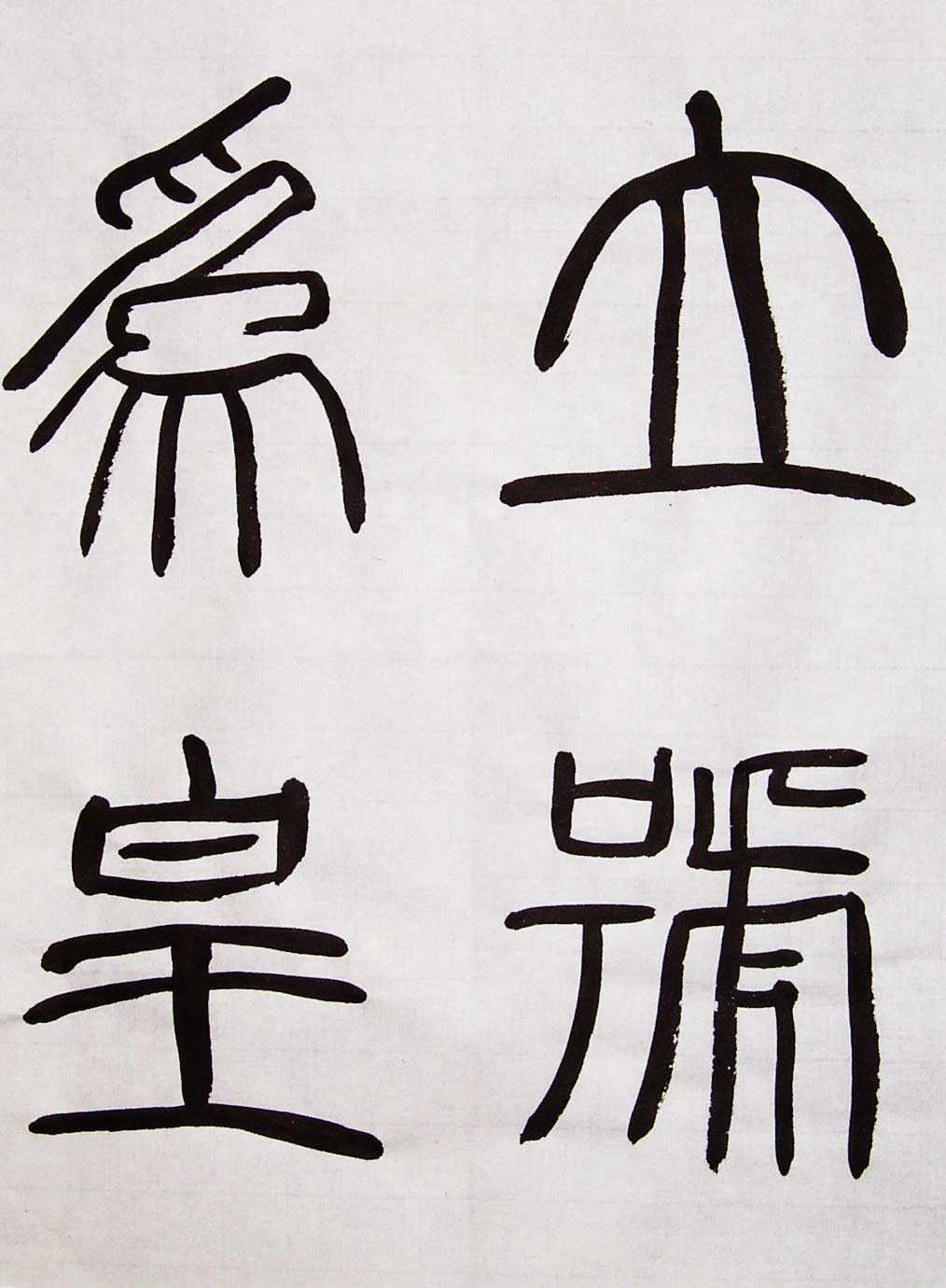
Put that all together and with a little practice you can make really good looking calligraphy. You can see some of examples of good calligraphy below.


Notice that all the styles are a little bit different. The style of the artist that drays the calligraphy as well as what the artist wants to say and what situation the calligraphy will be used all effect the end result. Which one do you like? Never mind the fact that you may not be able to read the words, just look at it like you would look at a painting. How does each of them make you feel?

Any way, it is now time for the word of the day. Today's word is 書道(しょどう). It is pronounced shodou and means calligraphy. Literally translated the symbols mean way of writing. I guess that makes sense.

That's it for today. See you next time at JJNN.

Wednesday, January 21, 2009

JJNN Wednesday: Games - 13

Welcome again to JJNN for Wednesday January 21st, 2009. Today we will be talking about the Metal Gear Solid Series.

Metal Gear Solid is a video game series that dates back to 1998. The game was a huge hit that sold over 6 million copies. The director of the series, Kojima Hideo, went on to make many sequels and prequels to the original game. The basic story is about a solder with the code name Solid Snake. He goes onto missions and has the plot of the games unfold around him. In the original game he is young, but in the newest installment he is getting up there in age. Just to give you a feel of the game here is a look at the newest game:


This game is not really news because it came out a little while ago. The news is where the series director got his inspiration for the series in the first place. It turns out that Kojima Hideo is a huge movie fan. He loves to watch lots of movies and absorb their ideas. According to this article Kojima Hideo got together with Tsutaya (sort of like the Blockbusters/Net Flix of Japan) to share with everyone the movies that gave him inspiration for this game series. There are 15 movies. If you know the movies and the game series see if you can connect the dots between the two.

Here are the movies in no particular order:
The Guns of Navarone
The Great Escape
Goldfinger
2001: A Space Odyssey
Planet of the Apes
The Deer Hunter
Dawn of the Dead
Full Metal Jacket
Predator
Die Hard
Heat
Black Hawk Down
Children of Men
The Bourne Identity
Casino Royal

There are some really good classic movies in there mixed up with some more modern fair. All in all a good list of movies to watch whether you are interested in the video game series or not.

Any way, it is now time for the word of the day. Today's word is 映画(えいが). It is pronounced eiga and means movie. The movies in Japan are so expensive to go to. I can bring my whole family to watch a movie in America for the same price as one ticket in Japan. Bah!

That's it for today. See you next time at JJNN.

Tuesday, January 20, 2009

JJNN Tuesday: Entertainment - 14

Welcome again to JJNN for Tuesday January 20th, 2009. Today we will be talking about studio 4°C.

There are many different studios out there that produce animation. Probably the most well known studio is Studio Ghibli. Studio Ghibli is the animation studio that did such famous movies as "Princess Mononoke" and "My Neighbor Totoro." Another one of the studios out there is called Studio 4°C. Studio 4°C was set up on May second 1986 when Tanaka Eiko and Morimoto Kouji came together. The reason for the name of the studio is the fact that water is most dense at about 4°C. The studio said they wanted all of their works to be dense with meaning and full of life.

Studio 4°C has done a lot of work on movies, but their main line of animated work is on music videos. A couple of these music videos can be seen below.


Studio 4°C also does some work on commercials. Below you can see one of their more wacky car commercials. It basically tells the story of ...something... from the sea and how a family uses their car to get it back to the sea. Extremely strange by funny.


Any way, it is now time for the word of the day. Today's word is 摂氏(せっし). It is pronounced kasshi and means Celsius. In my own personal opinion Celsius kicks Fahrenheit's ass.

That's it for today. See you next time at JJNN.

Monday, January 19, 2009

JJNN Monday: Science - 13

Welcome again to JJNN for Monday January 19th, 2009. Today we will be talking about the Crafoord Prize.

What's that? You have never heard of the Crafoord prize? Well there is a good reason for that. It is over-shadowed by its bigger and stronger cousin the Nobel prize. The Nobel Prize and the Crafoord Prize are both given out by the same group of people, The Royal Swedish Academy of Sciences. They also have other prizes like Gregori Aminoff Prize in crystallography and The Rolf Schocks Prizes in math and arts, just to name a few. All the other prizes were created to compliment the Nobel Prize. Compliment is another way of saying filling in the gaps of the Nobel Prize by adding categories that are not in the original prize.

The Crafoord Prize has categories for astronomy, math, geoscience, and biosciences. The bioscience part of the award is divided into ecological prizes and prizes that have to do with rheumatoid arthritis. Why rheumatoid arthritis? Well that is because the person who established the prize, Holger Crafood, had rheumatoid arthritis. I guess it is always good to give money to people that are helping to cure something that you are afflicted with.

So, what does this have to do with Japan? Well this year two of the winners of the Crafoord Prize are from Japan. Their names are Kishimoto Tadamitsu and Hirano Toshio. They worked together in a research group from Osaka University to help isolate things called interleukins. So what are interleukins and what do they have to do with rheumatoid arthritis? Well interleukins are a type of molecule that is used by the immune system to communicate with different places though out the body. It is used to call white blood cells, but it can also be used to do other things like signal the body to start making antibodies and causes inflammation and fevers. I know these do not seem good, but in the end these things help us all live. The problem is when these interleukins are released in great abundance when they should not be. This happens in the case of rheumatoid arthritis. The interleukins are released and the body tells the white blood cells to start attacking the joints. People like Kishimoto Tadamitsu and Hirano Toshio helped discover the connection with interleukins and rheumatoid arthritis and helped find ways for people to deal with the terrible disease.

Any way, it is now time for the word of the day. Today's word is 関節リウマチ(かんせつりうまち). It is pronounced kansetsu riumachi and means rheumatoid arthritis. I can't imagine how much it must hurt to have your own immune system eating away at your joints. This is something I would never wish on anyone.

That's it for today. See you next time at JJNN.

Sunday, January 18, 2009

I'm back!

Hi all

How are you all doing? I have enjoyed my unscheduled vacation from the blog-sphere, but I think that it is about time that I come back. I will start again tomorrow with the same old schedule. Also, if anyone has any suggestions or comments let me know. I just want to make this blog one of the best ones out there for Japanese news etc.

Talk to you all again tomorrow.