Today I want to talk about the results of 2008 test of academic achievement that was given to all 6th year and 9th year (the last year in elementary school and the last year in jr. high school) students in Japan. I say all students, but there was one city that refused to give their students the test. The number of students in that city, called Inuyama in southern Japan, is insignificant when compared to the rest of the country, so we can ignore that I guess.
So, any way, picture this. You are part of the government of Japan. More precisely you are a part of MEXT (Ministry of Education, Culture, Sports, Science and Technology), the people that started the academic achievement tests in 2007. You gave the test last year and you did the year before. The problem is that you have all this raw data and have no idea what to do with it. What would you do with it? I have no idea what I would do with it myself. It is nearly impossible to find patterns with just one or two data points per child. A lot more information is needed to actually get anything useful out of the data. You have to compare the children that do well (or inversely not so well) in a subject to something else to see why they do well or poorly in that subject. MEXT chose the thing that makes the world go around, money. This comparison was only done for the 6th year students. This report can be seen in Japanese in the Kyoto Shimbun.
What do you think MEXT found when they compared the academic achievement scores to the next income of that child's household? I think you can all probably guess but, simply, they found that the more money that flows into a household the higher the test score. How did they reach that conclusion? Well, first, they sent a survey off to 8093 students families from 100 randomly chosen schools from 5 major cities. 5847 parents actually sent back the survey. The survey had questions about how much money the family makes, how much money goes into their child's after school education, and other things about their family.
The results seem straight forward. For example, the average of the achievement test in math was 55.8%. Students in families with an income of 2,000,000 yen (around 20,000 USD) a year produced an average score of 42.6% while students in families with an income between 12,000,000 and 15,000,000 ( about 120,000 to 150,000 USD) a year produced and average score of 65.9%. That is a difference of 23.3%.
Another example of the same thing can be seen in how much money is put into the children's after school education. The average family that put more than 50,000 yen (around 500 USD) into their children's after school education per month got a score of 71.2 while the students that didn't get after school education had an average score of 44.4% for a difference of 26.8%.
Those two differences are huge, but does this mean that poor people never get good grades in school? Of course not. There is one silver lining on this cloud of a report. It seems that even at the same economic level the families who read to their children when they were very young or had a lot of books in their home always produced better scores on the academic achievement tests. So, I guess this means that even the poorest of the poor can produce good students if they set them off on the correct path by reading to them when they are very young.
I want to end this post by saying that tests like this are a good way to ruin the education system. In the beginning they may seem like a good idea. They may seem like they may help the education system by finding flaws in the system and finding out where the kids are being left behind, but I wonder if that is what is really happening. If all they can think to do with all of the raw data they go was to compare it with how much money the children's families make I wonder if they should really give this test every year.
Any way, it is now time for the word of the day. Today's word is 学力(がくりょく). It is pronounced gakuryoku and means knowledge. I wish I had some gakuryoku now haha.
See you next time at JJNN
Friday, September 18, 2009


Tuesday, September 15, 2009
I'm in pain
Hi all
I know, I know. I just got back and I am already falling behind in my posts. There is a good reason. I am in a lot of pain. Last Sunday I went to a neighboring prefecture and climbed a mountain with my neighbor and his friends. Because of that I have a whole lot of muscle pain and my knees are killing me. Too much pain to think really. But, on the other hand, I had a really good time climbing the mountain and I think I will climb another one some time soon.
Any way, instead of just saying how painful it is I want to show you some pictures.
Enjoy!


I know, I know. I just got back and I am already falling behind in my posts. There is a good reason. I am in a lot of pain. Last Sunday I went to a neighboring prefecture and climbed a mountain with my neighbor and his friends. Because of that I have a whole lot of muscle pain and my knees are killing me. Too much pain to think really. But, on the other hand, I had a really good time climbing the mountain and I think I will climb another one some time soon.
Any way, instead of just saying how painful it is I want to show you some pictures.
Enjoy!


Friday, September 11, 2009
Giant Gundam
I was a little more busy than I though that I would be today so I didn't have time to actually look for a news story, so instead of news I will tell you a little about my summer vacation. Actually, even though I say summer vacation, I only had a few actual days off from work. I had a lot of summer camps to teach English to jr high school and elementary school students. It was fun, but it was just too busy. Though, one weekend I went to Tokyo with a couple of my friends. While I was in Tokyo one of my friends said we should go to a place called Odaiba. In one of the parks of Odaiba there was a giant (18 meter/59 foot tall) robot statue. This robot is from the anime called Gundam. It was really amazing to watch just from a logistical standpoint. I really wonder how they built it and why. All good questions, but it is also just fun to look at. So, below is a picture I took and a youtube video. Enjoy!


I'm back...again!
Hi all!
Do to some recent changes in my life (mainly getting rid of the translation class because it really wasn't going anywhere in the first place) I am back on the blogging scene! I don't know if I will be around as much as I used to be, but I will try my hardest to get the latest Japanese news to all of you. I don't have anything at the moment, but I will do some research and get back to you later today.
Do to some recent changes in my life (mainly getting rid of the translation class because it really wasn't going anywhere in the first place) I am back on the blogging scene! I don't know if I will be around as much as I used to be, but I will try my hardest to get the latest Japanese news to all of you. I don't have anything at the moment, but I will do some research and get back to you later today.
Wednesday, March 18, 2009
Update
Hi all.
I haven't really had time or energy lately to keep up with my blog, but I did get some good news today that I want to pass along to everyone. I got accepted to grad school in the UK. The program is an Masters in Advanced Japanese Studies (Japanese to English translation). This does not mean that I will be moving to the UK, because this is a correspondence course. Correspondence classes have a bad reputation but this is from a very famous UK school called Sheffield. As soon as the course starts (April 1st I will have even less time to update this blog, but I will try to keep it up.
It is going to feel good to be on the other side of the desk for once.
I haven't really had time or energy lately to keep up with my blog, but I did get some good news today that I want to pass along to everyone. I got accepted to grad school in the UK. The program is an Masters in Advanced Japanese Studies (Japanese to English translation). This does not mean that I will be moving to the UK, because this is a correspondence course. Correspondence classes have a bad reputation but this is from a very famous UK school called Sheffield. As soon as the course starts (April 1st I will have even less time to update this blog, but I will try to keep it up.
It is going to feel good to be on the other side of the desk for once.
Tuesday, March 10, 2009
JJNN: Audio Pareidolia
Welcome again to JJNN for March 10th, 2009. Today I will be talking more about that friend of ours, pareidolia.
Yesterday I talked about pareidolia and how it can make us see images in a random pattern. Well, as it turns out, pareidolia does not just affect the eyes. There is also an audio version of this phenomenon. A good example of that is electric voice phenomenon, or EVP. This happens when people listen to static or audio interference and think that they hear voice or similar sounds. Watch this next video on EVP and than I will point out some things about audio pareidolia that totally discredit the video.
The important thing here is not really the sound. The important thing is the suggestion that that sound is a voice that is saying something specific. Once someone suggests that a sound actually sounds like a certain word, it is hard to get that word out of our head when we hear that sound. For example, listen to the first "EVP" again but go in with the suggestion that the "voice" is saying "Man, it's hot this summer." Do you hear that the second time you listen to it? It is just a noise that our brain is trying to make into something that is important when it really isn't.
Another example of this audio pareidolia is misheard lyrics to songs. The following video is Wishmaster by Nightwish.
The lyrics are:
Master!
Apprentice!
Heartborne, 7th Seeker
Warrior!
Disciple!
In me the Wishmaster
Master!
Apprentice!
Heartborne, 7th Seeker
Warrior!
Disciple!
In me the Wishmaster
Elbereth
Lorien
A dreamy-eyed child staring into night
On a journey to storyteller`s mind
Whispers a wish speaks with the stars the words are silent in Him
Distant sigh from a lonely heart
"I`ll be with you soon, my Shalafi"
Grey Havens my destiny
Master!
Apprentice!
Heartborne, 7th Seeker
Warrior!
Disciple!
In me the Wishmaster
Silvara
Starbreeze
Sla-Mori the one known only by Him
To august realms, the sorcery within
If you hear the call of arcane lore,
Your world shall rest on Earth no more
A maiden elf calling with her cunning song
"Meet me at the Inn of Last Home"
Heartborne will find the way!
Master!
Apprentice!
Heartborne, 7th Seeker
Warrior!
Disciple!
In me the Wishmaster
Master!
Apprentice!
Heartborne, 7th Seeker
Warrior!
Disciple!
In me the Wishmaster
Wishmaster
Crusade for Your will
A child, dreamfinder
The Apprentice becoming...
Master!
Apprentice!
Heartborne, 7th Seeker
Warrior!
Disciple!
In me the Wishmaster
Master!
Apprentice!
Heartborne, 7th Seeker
Warrior!
Disciple!
In me the Wishmaster
Master!
Apprentice!
Heartborne, 7th Seeker
Warrior!
Disciple!
In me the Wishmaster
OK, now watch this video and see if you can hear the other set of lyrics.
Yesterday I talked about pareidolia and how it can make us see images in a random pattern. Well, as it turns out, pareidolia does not just affect the eyes. There is also an audio version of this phenomenon. A good example of that is electric voice phenomenon, or EVP. This happens when people listen to static or audio interference and think that they hear voice or similar sounds. Watch this next video on EVP and than I will point out some things about audio pareidolia that totally discredit the video.
The important thing here is not really the sound. The important thing is the suggestion that that sound is a voice that is saying something specific. Once someone suggests that a sound actually sounds like a certain word, it is hard to get that word out of our head when we hear that sound. For example, listen to the first "EVP" again but go in with the suggestion that the "voice" is saying "Man, it's hot this summer." Do you hear that the second time you listen to it? It is just a noise that our brain is trying to make into something that is important when it really isn't.
Another example of this audio pareidolia is misheard lyrics to songs. The following video is Wishmaster by Nightwish.
The lyrics are:
Master!
Apprentice!
Heartborne, 7th Seeker
Warrior!
Disciple!
In me the Wishmaster
Master!
Apprentice!
Heartborne, 7th Seeker
Warrior!
Disciple!
In me the Wishmaster
Elbereth
Lorien
A dreamy-eyed child staring into night
On a journey to storyteller`s mind
Whispers a wish speaks with the stars the words are silent in Him
Distant sigh from a lonely heart
"I`ll be with you soon, my Shalafi"
Grey Havens my destiny
Master!
Apprentice!
Heartborne, 7th Seeker
Warrior!
Disciple!
In me the Wishmaster
Silvara
Starbreeze
Sla-Mori the one known only by Him
To august realms, the sorcery within
If you hear the call of arcane lore,
Your world shall rest on Earth no more
A maiden elf calling with her cunning song
"Meet me at the Inn of Last Home"
Heartborne will find the way!
Master!
Apprentice!
Heartborne, 7th Seeker
Warrior!
Disciple!
In me the Wishmaster
Master!
Apprentice!
Heartborne, 7th Seeker
Warrior!
Disciple!
In me the Wishmaster
Wishmaster
Crusade for Your will
A child, dreamfinder
The Apprentice becoming...
Master!
Apprentice!
Heartborne, 7th Seeker
Warrior!
Disciple!
In me the Wishmaster
Master!
Apprentice!
Heartborne, 7th Seeker
Warrior!
Disciple!
In me the Wishmaster
Master!
Apprentice!
Heartborne, 7th Seeker
Warrior!
Disciple!
In me the Wishmaster
OK, now watch this video and see if you can hear the other set of lyrics.
Monday, March 9, 2009
JJNN: Subaru pareidolia
Welcome again to JJNN for March 9th, 2009. Today I will be talking about a Japanese contest.
I want to you take a look at a picture and tell me what you see. Just keep your eyes open and your mind blank and see what comes to you. Here is the picture, look hard.

So, what do you see? I will give you a hint. The giant picture is made by 339 cars. How is that a hint? Well, the picture has something to do with the cars that make up the picture. I will tell you about why all those cars came together and than I will tell you what the picture actually is.
This event all started in 2007 in Portugal. There was a group of people that want to get into the Guinness book of records. And like any respectful group that wants to get into the Guinness book of records, they decided to do something stupid. In this case it was to make a giant mosaic using just cars. They type of car that they used was a Japanese car, so some Japanese people that heard about the Guinness record decided that they should out do the Portuguese. There is Japanese pride on the line after all. So last saturday they got 339 cars made by the same company together and made a huge mosaic of that car's symbol. Did that hint help you figure out what car symbol it is? It is actually the Suburu symbol. Take a look at the symbol below and compare it to the mosaic above.

Does it actually look anything like the Suburu symbol? Well, I would say that it has a passing resemblance. But, of course before I knew what the Subuer symbol looked like I couldn't tell you what the mosaic was representing. This leads to something called pareidolia. Pareidolia is seeing an image in an random pattern (or in this case a pattern that is just hard to make out). There is also another version of pareidolia that covers hearing things in a random sound pattern.
Pareidolia has been the root cause of many different types of pseudoscience. The most obvious one is of course seeing the face of Jesus or Mary in the pattern caused by the grain of the wood or the pattern caused by the melted cheese stuck to the bottom of a pizza box. You can see one such example below.

So, why would this happen? Is Jesus really reaching out his all powerful hand and burning himself into a piece of bread for all to see? I would have to say a big "no!" to that question. What happens is that the burn pattern of the bread is natural and the image of Jesus is so engrained into everyone's heads (even those who are not religious have spent most of their lives seeing that image in different places) that it jumps out at us. All I got to say is that the next time you see the image of Jesus burnt onto some toast you better be looking for his signature in the bottom right hand corner of the burn mark before you believe it is a divine sign of anything.
I want to you take a look at a picture and tell me what you see. Just keep your eyes open and your mind blank and see what comes to you. Here is the picture, look hard.

So, what do you see? I will give you a hint. The giant picture is made by 339 cars. How is that a hint? Well, the picture has something to do with the cars that make up the picture. I will tell you about why all those cars came together and than I will tell you what the picture actually is.
This event all started in 2007 in Portugal. There was a group of people that want to get into the Guinness book of records. And like any respectful group that wants to get into the Guinness book of records, they decided to do something stupid. In this case it was to make a giant mosaic using just cars. They type of car that they used was a Japanese car, so some Japanese people that heard about the Guinness record decided that they should out do the Portuguese. There is Japanese pride on the line after all. So last saturday they got 339 cars made by the same company together and made a huge mosaic of that car's symbol. Did that hint help you figure out what car symbol it is? It is actually the Suburu symbol. Take a look at the symbol below and compare it to the mosaic above.

Does it actually look anything like the Suburu symbol? Well, I would say that it has a passing resemblance. But, of course before I knew what the Subuer symbol looked like I couldn't tell you what the mosaic was representing. This leads to something called pareidolia. Pareidolia is seeing an image in an random pattern (or in this case a pattern that is just hard to make out). There is also another version of pareidolia that covers hearing things in a random sound pattern.
Pareidolia has been the root cause of many different types of pseudoscience. The most obvious one is of course seeing the face of Jesus or Mary in the pattern caused by the grain of the wood or the pattern caused by the melted cheese stuck to the bottom of a pizza box. You can see one such example below.

So, why would this happen? Is Jesus really reaching out his all powerful hand and burning himself into a piece of bread for all to see? I would have to say a big "no!" to that question. What happens is that the burn pattern of the bread is natural and the image of Jesus is so engrained into everyone's heads (even those who are not religious have spent most of their lives seeing that image in different places) that it jumps out at us. All I got to say is that the next time you see the image of Jesus burnt onto some toast you better be looking for his signature in the bottom right hand corner of the burn mark before you believe it is a divine sign of anything.
Tuesday, March 3, 2009
JJNN: Remap
Welcome again to JJNN for March 3rd, 2009. Today I will be talking about the remapping of Japan.
There are a lot of little dangers when you live in the land of active volcanoes and earthquakes. I mean, your house could be swept away by a river of magma, or something could fall on you and kill you during an earthquake. Those are both terrible, but they don't even come close to the terror of not being able to find your way around with your car's navigation system. Sure, it is not as obvious as buildings falling down and burning to the ground, but that is also one of the side effects that you have to deal with when you live in land of active plate tectonics.
According to this news story, there have been changes in the landscape of Japan because of earthquakes and plate tectonics. A good example of this is Mt. Odaigahara in Southern Japan. The height of the mountain actually increased 12 centimeters (almost 5 inches) since last they measured how high it was. At another place in southern Japan the Geographical Survey Institute has to remeasure over 3000 triangulation points because they have moved. They are using GPSs to help make the measurements.
I will leave you with a picture of the new taller Mt. Odaigahara.

There are a lot of little dangers when you live in the land of active volcanoes and earthquakes. I mean, your house could be swept away by a river of magma, or something could fall on you and kill you during an earthquake. Those are both terrible, but they don't even come close to the terror of not being able to find your way around with your car's navigation system. Sure, it is not as obvious as buildings falling down and burning to the ground, but that is also one of the side effects that you have to deal with when you live in land of active plate tectonics.
According to this news story, there have been changes in the landscape of Japan because of earthquakes and plate tectonics. A good example of this is Mt. Odaigahara in Southern Japan. The height of the mountain actually increased 12 centimeters (almost 5 inches) since last they measured how high it was. At another place in southern Japan the Geographical Survey Institute has to remeasure over 3000 triangulation points because they have moved. They are using GPSs to help make the measurements.
I will leave you with a picture of the new taller Mt. Odaigahara.

Friday, February 27, 2009
JJNN: Earth Simulator 2
Welcome again to JJNN for February 26th, 2009. Today I will be talking about a new Japanese super computer.
You know, I love the idea of super computers. If you close your eyes and think about a super computer what do you think about? For some people it is probably HAL from 2001 a Space Odyssey or maybe you think about rows upon rows of computer banks with magnetic tape recording and readouts. I guess I am in the camp of the second way of thinking. It may be a little out dated, but it is just cool.
The first super computer I have ever heard about was the Japanese super computer the Earth Simulator. It was the fastest super computer in the world from 2002 to 2004. It was made to simulate the effects of global warming on a grand scale. It was really amazing for its time, but it was huge. All in all, the Earth Simulator 640 nodes (individual computers). Each node had 16 processors and 16 Gb of memory. Two of the individual computers were put in the same case and each case consumed 20 kW of power. That means the total power consumption was 6400 kW. Ouch. But, on the bright side, a lot of calculations could be performed per second. The number of calculations a computer can perform per second is called a FLOPS (Floating point Operation Per Second). How many could the original Earth Simulator perform? 35.86 * 10^12 FLOPS. That's right, almost 36 trillion operations per second. That used to be the fastest computer in the world, but now it is a mere 72nd place.
Here is where the big news comes in. You can find the original article here. The company that made the first Earth Simulator, the Japanese Agency for Marine-Earth Science and Technology (JAMSTEC), is coming back to make an Earth Simulator 2. This is going to be leaner and more powerful than the first Earth Simulator. Instead of the 640 nodes of the first one, there will be only 160 nodes. Each node will be much more powerful than the nodes in the first Earth Simulator. Because there are fewer computer the amount of energy used it reduced. In fact JAMSTEC said the power usage should go down by as much as 80%. But, the most important thing is how many FLOPS is can perform. The new Earth Simulator can perform 131 * 10^12 FLOPS. That would be a whole lot. The only thing is, it is not the fastest in the world. The fastest super computer is the IBM Roadrunner with a whopping 1105 *10^12 FLOPS.
I will leave you a picture of the new Earth Simulator.

You know, I love the idea of super computers. If you close your eyes and think about a super computer what do you think about? For some people it is probably HAL from 2001 a Space Odyssey or maybe you think about rows upon rows of computer banks with magnetic tape recording and readouts. I guess I am in the camp of the second way of thinking. It may be a little out dated, but it is just cool.
The first super computer I have ever heard about was the Japanese super computer the Earth Simulator. It was the fastest super computer in the world from 2002 to 2004. It was made to simulate the effects of global warming on a grand scale. It was really amazing for its time, but it was huge. All in all, the Earth Simulator 640 nodes (individual computers). Each node had 16 processors and 16 Gb of memory. Two of the individual computers were put in the same case and each case consumed 20 kW of power. That means the total power consumption was 6400 kW. Ouch. But, on the bright side, a lot of calculations could be performed per second. The number of calculations a computer can perform per second is called a FLOPS (Floating point Operation Per Second). How many could the original Earth Simulator perform? 35.86 * 10^12 FLOPS. That's right, almost 36 trillion operations per second. That used to be the fastest computer in the world, but now it is a mere 72nd place.
Here is where the big news comes in. You can find the original article here. The company that made the first Earth Simulator, the Japanese Agency for Marine-Earth Science and Technology (JAMSTEC), is coming back to make an Earth Simulator 2. This is going to be leaner and more powerful than the first Earth Simulator. Instead of the 640 nodes of the first one, there will be only 160 nodes. Each node will be much more powerful than the nodes in the first Earth Simulator. Because there are fewer computer the amount of energy used it reduced. In fact JAMSTEC said the power usage should go down by as much as 80%. But, the most important thing is how many FLOPS is can perform. The new Earth Simulator can perform 131 * 10^12 FLOPS. That would be a whole lot. The only thing is, it is not the fastest in the world. The fastest super computer is the IBM Roadrunner with a whopping 1105 *10^12 FLOPS.
I will leave you a picture of the new Earth Simulator.

Wednesday, February 25, 2009
JJNN: Influenza
Welcome again to JJNN for February 25th, 2009. Today I will be talking about influenza.
During this time of the year "influenza" is almost like a dirty word. No one ever wants to deal with getting influenza. Of course the easiest way to avoid getting influenza is to avoid anyone that even looks the least bit sick. Well, things like getting a flu shot and taking care of your self works as well, but who wants to go to all that work?
It turns out the Japanese National Institute of Infectious Diseases (NIID) is really worried about a new type of foreign strain of influenza virus making it's way into Japan. They set up models to to see how a new type of flu virus will spread in Tokyo and the areas around Tokyo if just one office worker brings back the virus from a foreign country. It is actually interesting how they came up with the model. It seems they took a sampling of 34,000,000 people that live in Tokyo and in all the prefectures that surround Tokyo. They tracked how these people get from place to place as well as where these people were during the day. From this data they were able to tell who would come into contact with who. In other words they can tell how many people come into contact with the person that is sick. If you assume that most of the people that come into contact with the virus will get sick (this is a good assumption because the Japanese people do not have antibodies for the new type of flu) than you can figure out how many people will get sick. Now here is the fun part. You have to take all those people and figure out how many people they meet and do the same thing as you did with the first person. As you can see, the numbers of people that get sick gets big real fast. This would be the start of an epidemic.
NIID ran many different simulations on their model to find the best way to reduce the number of people that might come down with the new flu virus. They found the best way deal with the problem was to make sure people don't walk around spreading the disease. The results are amazing. If no actions are taken 51.6% of all the people around Tokyo could come down with the flu. If all the schools (from pre-school to university) are closed down this only drops to 47.4%. That is not a very big drop. If all the schools are closed and 40% of the people that would normal go to work would stay home the number of people that will get sick goes down to 19.1%. And if the number of people staying home from work rises to 60% the number of that would get sick goes down to a nice 9.5%. It is worth mentioning that around 9% is the infection rate for the flu virus on a normal year in Japan. That is a lot of numbers but here it what it would look like visually.

During this time of the year "influenza" is almost like a dirty word. No one ever wants to deal with getting influenza. Of course the easiest way to avoid getting influenza is to avoid anyone that even looks the least bit sick. Well, things like getting a flu shot and taking care of your self works as well, but who wants to go to all that work?
It turns out the Japanese National Institute of Infectious Diseases (NIID) is really worried about a new type of foreign strain of influenza virus making it's way into Japan. They set up models to to see how a new type of flu virus will spread in Tokyo and the areas around Tokyo if just one office worker brings back the virus from a foreign country. It is actually interesting how they came up with the model. It seems they took a sampling of 34,000,000 people that live in Tokyo and in all the prefectures that surround Tokyo. They tracked how these people get from place to place as well as where these people were during the day. From this data they were able to tell who would come into contact with who. In other words they can tell how many people come into contact with the person that is sick. If you assume that most of the people that come into contact with the virus will get sick (this is a good assumption because the Japanese people do not have antibodies for the new type of flu) than you can figure out how many people will get sick. Now here is the fun part. You have to take all those people and figure out how many people they meet and do the same thing as you did with the first person. As you can see, the numbers of people that get sick gets big real fast. This would be the start of an epidemic.
NIID ran many different simulations on their model to find the best way to reduce the number of people that might come down with the new flu virus. They found the best way deal with the problem was to make sure people don't walk around spreading the disease. The results are amazing. If no actions are taken 51.6% of all the people around Tokyo could come down with the flu. If all the schools (from pre-school to university) are closed down this only drops to 47.4%. That is not a very big drop. If all the schools are closed and 40% of the people that would normal go to work would stay home the number of people that will get sick goes down to 19.1%. And if the number of people staying home from work rises to 60% the number of that would get sick goes down to a nice 9.5%. It is worth mentioning that around 9% is the infection rate for the flu virus on a normal year in Japan. That is a lot of numbers but here it what it would look like visually.

Tuesday, February 24, 2009
JJNN: Academy Award
Welcome again to JJNN for February 24th, 2009. Today I will be talking about the Academy Awards.
Wait a second! What does the Academy Awards have to do with Japan? Actually, this year it has a lot to do with Japan. This is the first year that a Japanese movie has actually won at the Academy Awards. But, actually, there were two Japanese movies that took prizes at the Academy Awards this year.
The first one has the English title Departures. Departures is the story of a person that worked as a celloist up until the point where the land he is working in falls apart. He ends up selling his cello and moving back into his old family house. He has no job so he goes to a job interview. The job advertisement said they wanted someone to help people depart. He thought it was for a travel agent, but it turned out to be for a company that helps prepare dead bodies for burial (not depart as in fly away but die as it turns out). He has no other source of income so he takes the job. After a while he accepts the job and takes pride in it. The rest of the movie is about how people treat the main character when they find out what his job is. All in all a good movie from what I have heard. I will have to see it some time.
The second movie is called The House Made out of Building Blocks. This is a short animated sequence that tells the story of one man and his past while also bring in the subject of the environment. All in all it sounds heavy, but it is a good animation. I was able to find it on youtube so you can watch it in its entirety. Enjoy.
Part 1
Part 2
You might want to watch those fast because they will probably be erased from youtube soon. Damn copyright.
Wait a second! What does the Academy Awards have to do with Japan? Actually, this year it has a lot to do with Japan. This is the first year that a Japanese movie has actually won at the Academy Awards. But, actually, there were two Japanese movies that took prizes at the Academy Awards this year.
The first one has the English title Departures. Departures is the story of a person that worked as a celloist up until the point where the land he is working in falls apart. He ends up selling his cello and moving back into his old family house. He has no job so he goes to a job interview. The job advertisement said they wanted someone to help people depart. He thought it was for a travel agent, but it turned out to be for a company that helps prepare dead bodies for burial (not depart as in fly away but die as it turns out). He has no other source of income so he takes the job. After a while he accepts the job and takes pride in it. The rest of the movie is about how people treat the main character when they find out what his job is. All in all a good movie from what I have heard. I will have to see it some time.
The second movie is called The House Made out of Building Blocks. This is a short animated sequence that tells the story of one man and his past while also bring in the subject of the environment. All in all it sounds heavy, but it is a good animation. I was able to find it on youtube so you can watch it in its entirety. Enjoy.
Part 1
Part 2
You might want to watch those fast because they will probably be erased from youtube soon. Damn copyright.
Monday, February 23, 2009
JJNN: LED veggies
Welcome again to JJNN for February 23rd, 2009. Today I will be talking about a new way of growing vegetables.
A farming venture company in Kyoto named Fairy Angle (what a name, huh?) has been experimenting with different ways for growing vegetables. They have been using lights of different colors as different stages of development to make sure the vegetable turns out shaped well and full of nutrients. You can see the original article here.
The company believes that if the vegetables are grown with red light they will undergo a faster form of photosynthesis and thus lead to bigger and more nutritious vegetables. This got me thinking. Could it really be true that different color lights could change the rate of something as natural as photosynthesis? I went and did some poking around the internet and found this article put out by CU Boulder in 2001. The gist of the article is that red light might speed up photosynthesis just a little bit, but that is really lost within the noise of the experiment. In other words, it is not really measurable, which means it might not even exist.
The Kyoto company also says blue light helps the vegetable take its shape. I don't really get this. You never see carrots come out of the ground looking like pumpkins just because they didn't get any blue light. Well, I guess I can't say that because blue light is included in the white light that the vegetables get. Maybe I should do my own experiment with a darkroom, some red lights and carrot seeds.
The article also states that they are using green lights. That made me shake my head. The leaves of the vegetable are green because they are reflecting back all of the green light. If you shine just green light on a plant it would be just the same as keeping the plant in a dark room.
Normally something like this would never get into the news, but this company made a change. They changed from normal colored light bulbs to LED lights. They are being shown as great pioneers that are thinking of the environment while trying to produce new plants. The truth is that the best way to think of the environment is to let the plants grow outside in normal sunlight.
I will leave you a picture of this vegetable factory.

A farming venture company in Kyoto named Fairy Angle (what a name, huh?) has been experimenting with different ways for growing vegetables. They have been using lights of different colors as different stages of development to make sure the vegetable turns out shaped well and full of nutrients. You can see the original article here.
The company believes that if the vegetables are grown with red light they will undergo a faster form of photosynthesis and thus lead to bigger and more nutritious vegetables. This got me thinking. Could it really be true that different color lights could change the rate of something as natural as photosynthesis? I went and did some poking around the internet and found this article put out by CU Boulder in 2001. The gist of the article is that red light might speed up photosynthesis just a little bit, but that is really lost within the noise of the experiment. In other words, it is not really measurable, which means it might not even exist.
The Kyoto company also says blue light helps the vegetable take its shape. I don't really get this. You never see carrots come out of the ground looking like pumpkins just because they didn't get any blue light. Well, I guess I can't say that because blue light is included in the white light that the vegetables get. Maybe I should do my own experiment with a darkroom, some red lights and carrot seeds.
The article also states that they are using green lights. That made me shake my head. The leaves of the vegetable are green because they are reflecting back all of the green light. If you shine just green light on a plant it would be just the same as keeping the plant in a dark room.
Normally something like this would never get into the news, but this company made a change. They changed from normal colored light bulbs to LED lights. They are being shown as great pioneers that are thinking of the environment while trying to produce new plants. The truth is that the best way to think of the environment is to let the plants grow outside in normal sunlight.
I will leave you a picture of this vegetable factory.

Saturday, February 21, 2009
JJNN: Station Boxed Lunches
Welcome again to JJNN for February 21st, 2009. Today I will be talking about magical boxes filled with delicious food.
The Japanese have a tradition of traveling around and eating the delicious foods in that area. There is even a place only a few hours by train from where I live that is known for it's ramen. So right in the train station is a map of all the ramen shops in the town. You can take the map and go from shop to shop eating different types of ramen. There is another place a little further away that is known for it croquettes. You can walk from shop to shop and try the croquettes with different fillings.
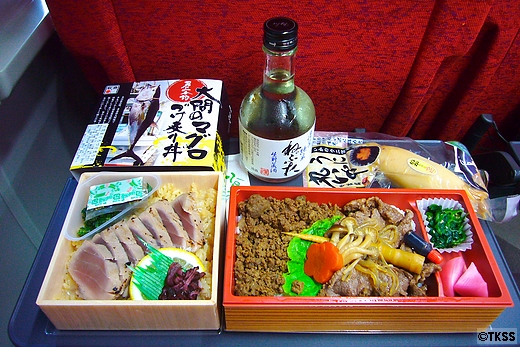
You don't have to go to the different towns to get the different types of food that are famous in an area. There are such things as Station Boxed Lunches (in Japanese they are called eki-ben). They are usually sold inside a train car, but some times you have to get off the train at the area to get the food. I love eki-ben. It is a little expensive, but it is always filling. You can see some pictures of eki-ben below.


They look good, don't they. The top picture shows two eki-ben. They have both fish and meat. They both look very good. The bottom one has meat and lots of different side dishes. These things are making me very hungry. The reason I am talking about eki-ben today is because of this article. The article is about the eki-ben is kyushu (one of the smaller islands in Japan). It sounds out for the second year in a row the eki-ben named kirei-gawa is the number one eki-ben in kyushu.
That is no small feat because the field is 50 different types of bento. Kirei-gawa has lots of mushroom and deep fried potatoes and rice that was cooked with different types of vegetables. It will set you back 1050 yen (around 10USD). Kyushu is a little bit far away so I don't think Iw ill ever eat this eki-ben, but if I am ever in the area I will be sure to try the number one. Yummmm
The Japanese have a tradition of traveling around and eating the delicious foods in that area. There is even a place only a few hours by train from where I live that is known for it's ramen. So right in the train station is a map of all the ramen shops in the town. You can take the map and go from shop to shop eating different types of ramen. There is another place a little further away that is known for it croquettes. You can walk from shop to shop and try the croquettes with different fillings.
You don't have to go to the different towns to get the different types of food that are famous in an area. There are such things as Station Boxed Lunches (in Japanese they are called eki-ben). They are usually sold inside a train car, but some times you have to get off the train at the area to get the food. I love eki-ben. It is a little expensive, but it is always filling. You can see some pictures of eki-ben below.

They look good, don't they. The top picture shows two eki-ben. They have both fish and meat. They both look very good. The bottom one has meat and lots of different side dishes. These things are making me very hungry. The reason I am talking about eki-ben today is because of this article. The article is about the eki-ben is kyushu (one of the smaller islands in Japan). It sounds out for the second year in a row the eki-ben named kirei-gawa is the number one eki-ben in kyushu.
That is no small feat because the field is 50 different types of bento. Kirei-gawa has lots of mushroom and deep fried potatoes and rice that was cooked with different types of vegetables. It will set you back 1050 yen (around 10USD). Kyushu is a little bit far away so I don't think Iw ill ever eat this eki-ben, but if I am ever in the area I will be sure to try the number one. Yummmm
Thursday, February 19, 2009
JJNN: Random Animations
Welcome again to JJNN for February 19th, 2009. Today I will be having a lazy day.
Every so often I just want to be lazy. I actually have a reason today though. I didn't get back home until after 9 so I have no real time to look for anything good to write about. So, instead of having thoughtful discussion I will show random animations from Japanese artists.
This first one is from a student artist. The person made this animation out of different cloths. In the notes to the film it says the the main fish is a type of sea bream.
The second animation is all about natto. Natto is a Japanese food that is made from (actually is 100 percent) fermented soy beans. Natto is known for being sticky and slippery at the same time. Also when you try to eat it long strings of some sort of stuff (I still don't know what it is) go from one piece of natto to another. It makes it very hard to eat. That and most people don't like the taste or the smell. Any way this video is all about natto and how people (literally) sing its praises.
At the end of that last video the guy says "oishikunai" which means "It doesn't taste good." The last video doesn't have audio, but is good. It is the story of how this guy is trying to get candy that is on the top of a high shelf. Being as short as I am I feel his pain.
Any way, that is the limit to my laziness for today. I hope you all enjoyed and depending on how drunk I get tomorrow I will probably do the same. (By the way I have a reason for getting drunk...I passed the highest level of the Japanese proficiency test so I have to celebrate. Yay!)
Every so often I just want to be lazy. I actually have a reason today though. I didn't get back home until after 9 so I have no real time to look for anything good to write about. So, instead of having thoughtful discussion I will show random animations from Japanese artists.
This first one is from a student artist. The person made this animation out of different cloths. In the notes to the film it says the the main fish is a type of sea bream.
The second animation is all about natto. Natto is a Japanese food that is made from (actually is 100 percent) fermented soy beans. Natto is known for being sticky and slippery at the same time. Also when you try to eat it long strings of some sort of stuff (I still don't know what it is) go from one piece of natto to another. It makes it very hard to eat. That and most people don't like the taste or the smell. Any way this video is all about natto and how people (literally) sing its praises.
At the end of that last video the guy says "oishikunai" which means "It doesn't taste good." The last video doesn't have audio, but is good. It is the story of how this guy is trying to get candy that is on the top of a high shelf. Being as short as I am I feel his pain.
Any way, that is the limit to my laziness for today. I hope you all enjoyed and depending on how drunk I get tomorrow I will probably do the same. (By the way I have a reason for getting drunk...I passed the highest level of the Japanese proficiency test so I have to celebrate. Yay!)
Wednesday, February 18, 2009
JJNN: Nano pyramids
Welcome again to JJNN for February 18th, 2009. Today I will be talking about very small pyramids.
There is something cool about tiny things. In this day and age products sell better or news stories are read more if they contain the word "nano". So, what exactly is nano all about? It stands for one billionth of something. It could be anything from a nanosecond to a nanometer. Either way it is a very tiny thing. This is also where we get the term nano-machines. It just means a really really really small machine.
So, according to this article, a Japanese group was able to produce the first pyramids on the nano scale. They came up with an interesting way of making these things. First they make a solution that is made up of silver ions. A near infrared laser is than shown into the solution and the silver solidifies because of laser light. The team is making tiny pyramids that measure 1/500 of a millimeter with this process. The team uses a surfactant to make a the pyramids hollow inside. You can see a picture of these pyramids below.

What make these little pyramids amazing is the fact that they turn out in the shape the researchers want them to turn out in. Constructions that small have been made before, but they always turn out irregular. Now that these things can be produced in a regular way they can be used in integrated circuit technology and on the medical front. It will be interesting to see how these things will be used in the future.
There is something cool about tiny things. In this day and age products sell better or news stories are read more if they contain the word "nano". So, what exactly is nano all about? It stands for one billionth of something. It could be anything from a nanosecond to a nanometer. Either way it is a very tiny thing. This is also where we get the term nano-machines. It just means a really really really small machine.
So, according to this article, a Japanese group was able to produce the first pyramids on the nano scale. They came up with an interesting way of making these things. First they make a solution that is made up of silver ions. A near infrared laser is than shown into the solution and the silver solidifies because of laser light. The team is making tiny pyramids that measure 1/500 of a millimeter with this process. The team uses a surfactant to make a the pyramids hollow inside. You can see a picture of these pyramids below.

What make these little pyramids amazing is the fact that they turn out in the shape the researchers want them to turn out in. Constructions that small have been made before, but they always turn out irregular. Now that these things can be produced in a regular way they can be used in integrated circuit technology and on the medical front. It will be interesting to see how these things will be used in the future.
Tuesday, February 17, 2009
JJNN: Maido 1 update
Welcome again to JJNN for February 17th, 2009. Today I will be giving a quick update of Maido 1.
I talked about Maido 1 back on February 12th. This has quickly become my favorite satellite. Well, actually, I guess I don't have a ranking of satellites that I like, but if I did it would be on the top I guess. As I said before, the job of Maido 1 is to gather data about lighting and electric storms.
Well, as it turns out, Maido 1 got it's first real look at lighting over the weekend. In it's orbit Maido 1 caught a glimpse of lighting over Africa and Australia. This detection of lighting was not planned, but it ended up being a good test for the Maido 1's sensors. The person that designed Maido 1's sensors says that the sensors could clearly detect the lighting and everything checked out just fine.
To put a face (?) with the name Maido 1 I included a picture of the satellite below. Enjoy.

I talked about Maido 1 back on February 12th. This has quickly become my favorite satellite. Well, actually, I guess I don't have a ranking of satellites that I like, but if I did it would be on the top I guess. As I said before, the job of Maido 1 is to gather data about lighting and electric storms.
Well, as it turns out, Maido 1 got it's first real look at lighting over the weekend. In it's orbit Maido 1 caught a glimpse of lighting over Africa and Australia. This detection of lighting was not planned, but it ended up being a good test for the Maido 1's sensors. The person that designed Maido 1's sensors says that the sensors could clearly detect the lighting and everything checked out just fine.
To put a face (?) with the name Maido 1 I included a picture of the satellite below. Enjoy.

Monday, February 16, 2009
JJNN: NEDO
Welcome again to JJNN for February 16th, 2009. Today we will be talking about robots.
I watched a lot of TV as a child. When I was very young my family didn't have cable TV so I was forced to watch the free TV stations. My favorite TV channel was PBS. I spent hours watching such shows as Discovery and NOVA. Every so often one of those TV programs would do a show on robots. They would say how great robots were and how great they would become. I lost track of the times that I hard that all homes in America would have robots in them by 2010. Well, it's early in 2009, but I can't see a golden age of robot help in the home around any corner. Where is my robot!? I want my robot, damn it!
Well that is where this news article and NEDO steps in. What's NEDO, you may ask. Well NEDO stands for New Energy and Industrial Technology Development Organization. Technically I guess it should be NEITDO, but that is not as easy to say. NEDO is an organization that started way back in 1980 because of the oil crisis . Back than it was all about finding an energy source to replace oil. They started to look into industrial technology in 1988. Ever since 2006 they have been holding their robotics contest. The contest for this year is geared towards robots that could be mass produced for 2015 (only 5 years after the 2010 prediction from NOVA)
The NEDO robotics contest hard 3 distinct categories: advancements in the field of industrial robotics, advancements in the field of robots used in medical facilities, and advancements in field of robots used in emergencies. Though there were 18 robots in the running in the three categories, only 6 ended up getting any prize.
There were also demonstrations at the contest. The first robotic demonstration was a robot that goes around a hospital and passes out medicine and other such things. Personally I don't think this would fly in America because that robot would probably be pried open within an hour of it starting to operate. A defenseless robot with narcotics inside of it... not going to work.
The second robot is a rescue robot. It weighs about 20 Kg (about 44 pounds) and can be used to go into places that are too dangerous or tight for humans to enter. The robot sports a fisheye lens camera and infrared camera. A special software uses the information from the cameras to make a 3D map of the area. That is all nice, but in the end this is basically a really mobile radio controlled car that has cameras strapped to it. You can see a picture of the hospital robot (the upper picture) and the rescue robot (the lower picture) below.


I watched a lot of TV as a child. When I was very young my family didn't have cable TV so I was forced to watch the free TV stations. My favorite TV channel was PBS. I spent hours watching such shows as Discovery and NOVA. Every so often one of those TV programs would do a show on robots. They would say how great robots were and how great they would become. I lost track of the times that I hard that all homes in America would have robots in them by 2010. Well, it's early in 2009, but I can't see a golden age of robot help in the home around any corner. Where is my robot!? I want my robot, damn it!
Well that is where this news article and NEDO steps in. What's NEDO, you may ask. Well NEDO stands for New Energy and Industrial Technology Development Organization. Technically I guess it should be NEITDO, but that is not as easy to say. NEDO is an organization that started way back in 1980 because of the oil crisis . Back than it was all about finding an energy source to replace oil. They started to look into industrial technology in 1988. Ever since 2006 they have been holding their robotics contest. The contest for this year is geared towards robots that could be mass produced for 2015 (only 5 years after the 2010 prediction from NOVA)
The NEDO robotics contest hard 3 distinct categories: advancements in the field of industrial robotics, advancements in the field of robots used in medical facilities, and advancements in field of robots used in emergencies. Though there were 18 robots in the running in the three categories, only 6 ended up getting any prize.
There were also demonstrations at the contest. The first robotic demonstration was a robot that goes around a hospital and passes out medicine and other such things. Personally I don't think this would fly in America because that robot would probably be pried open within an hour of it starting to operate. A defenseless robot with narcotics inside of it... not going to work.
The second robot is a rescue robot. It weighs about 20 Kg (about 44 pounds) and can be used to go into places that are too dangerous or tight for humans to enter. The robot sports a fisheye lens camera and infrared camera. A special software uses the information from the cameras to make a 3D map of the area. That is all nice, but in the end this is basically a really mobile radio controlled car that has cameras strapped to it. You can see a picture of the hospital robot (the upper picture) and the rescue robot (the lower picture) below.


Friday, February 13, 2009
JJNN: Kaguya
Welcome again to JJNN for February 13th, 2009. Today we will be talking about yet another Japanese satellite.
Way back on October 27th of last year I talked about a Japanese satellite called kaguya. The last news report was about how kaguya failed to find water on the moon. This news report (found here) is about how kaguya was able to accurately map the surface of the moon.
Kaguya has been flying around the moon for a while now measuring altitude (I sort of want to say distance above sea level, but there is no sea on the moon) of the moon surface. This is the first time in history that a moon topographical map has been made with such great detail. The last moon map was made with about 270,000 data points, but the map that was made with kaguya has 6,770,000 data points. That tells a whole lot about the surface of the moon. You can see the map that was created by kaguya below.

The view below also shows the highest point (circled in black) and the lowest point (circled in white).

So, what can we learn from this map? Well, the distance around the moon at the equator is 1783.64 Km (1108.30 miles) and the distance around the moon from pole to pole is 1735.66 Km (1078.49 miles). These numbers are very close to each other, which means the moon is a near perfect sphere. It also turns out that the difference in height between the highest point on the moon and lowest point on the moon is a mere 19.81 Km (12.31 miles).
Now that kaguya has finished it's job of mapping the moon it really doesn't have anything left to do. It will fall out of orbit and crash on to the moon's surface later this year. I am sort of say to think that it is just going to end up as trash on the surface of the moon, but I guess it gave us a lot for the trade off of a little trash.
Way back on October 27th of last year I talked about a Japanese satellite called kaguya. The last news report was about how kaguya failed to find water on the moon. This news report (found here) is about how kaguya was able to accurately map the surface of the moon.
Kaguya has been flying around the moon for a while now measuring altitude (I sort of want to say distance above sea level, but there is no sea on the moon) of the moon surface. This is the first time in history that a moon topographical map has been made with such great detail. The last moon map was made with about 270,000 data points, but the map that was made with kaguya has 6,770,000 data points. That tells a whole lot about the surface of the moon. You can see the map that was created by kaguya below.

The view below also shows the highest point (circled in black) and the lowest point (circled in white).

So, what can we learn from this map? Well, the distance around the moon at the equator is 1783.64 Km (1108.30 miles) and the distance around the moon from pole to pole is 1735.66 Km (1078.49 miles). These numbers are very close to each other, which means the moon is a near perfect sphere. It also turns out that the difference in height between the highest point on the moon and lowest point on the moon is a mere 19.81 Km (12.31 miles).
Now that kaguya has finished it's job of mapping the moon it really doesn't have anything left to do. It will fall out of orbit and crash on to the moon's surface later this year. I am sort of say to think that it is just going to end up as trash on the surface of the moon, but I guess it gave us a lot for the trade off of a little trash.
Thursday, February 12, 2009
JJNN Maido 1
Welcome again to JJNN for February 12th, 2009. Today we will be talking about a satellite.
As I talked about on January 23rd there was a a lot of satellites were put into orbit by the successful launch of an H2A rocket from southern Japan. One of those satellites was called Maido 1. The job Maido 1 is suppose to perform is collecting data for the modeling of electric storms, bit it is not quite ready to take data at the moment. So, instead of just letting the satellite orbit without a purpose while it is preparing to gather data, the scientists affixed some cameras to the satellite.
There are actually 2 different types of cameras. The first one is used to take pictures of the Earth and the second one is going to be used to take pictures of the moon and skies. The name of the camera maker is Shikino Hi Tech. It is a very high definition camera and took the following picture.

It is a little hard to figure out what the picture actually shows because of all of the clouds, but that is Japan. You can see Japan's southern islands to the left of the picture. I am a little sad that you can't see where I live because of the clouds, but you get used to clouds when you live where I live. But, what makes this picture amazing in my opionion is that the satellite was 666 km (about 414 miles) above the earth when the picture was taken. I wonder how much that camera cost.
As I talked about on January 23rd there was a a lot of satellites were put into orbit by the successful launch of an H2A rocket from southern Japan. One of those satellites was called Maido 1. The job Maido 1 is suppose to perform is collecting data for the modeling of electric storms, bit it is not quite ready to take data at the moment. So, instead of just letting the satellite orbit without a purpose while it is preparing to gather data, the scientists affixed some cameras to the satellite.
There are actually 2 different types of cameras. The first one is used to take pictures of the Earth and the second one is going to be used to take pictures of the moon and skies. The name of the camera maker is Shikino Hi Tech. It is a very high definition camera and took the following picture.

It is a little hard to figure out what the picture actually shows because of all of the clouds, but that is Japan. You can see Japan's southern islands to the left of the picture. I am a little sad that you can't see where I live because of the clouds, but you get used to clouds when you live where I live. But, what makes this picture amazing in my opionion is that the satellite was 666 km (about 414 miles) above the earth when the picture was taken. I wonder how much that camera cost.
Wednesday, February 11, 2009
JJNN: Beautiful Princess
Welcome again to JJNN for February 11th, 2009. Today we will be talking about expensive Japanese fruit.
I love strawberries. I used to eat tiny wild strawberries with milk. Since we got the strawberries from our front yard at the time, they were free. I sort of liked that. Sure, they were small, but free is a good thing. Looking though some news stories today I stumbled over a story (shown here) about a person named Okuda Mikio who found a way to grow huge strawberries that are suppose to be very sweet. You can see a picture of these strawberries below.

They look good, right? They should. Mr. Okuda is calling them Bijin-hime which means beautiful princess. Each one is about 80 grams (amlost 3 oz) which is almost 3 times the weight of a normal strawberry grown in that area. The name of the strawberries grown in that prefecture are no-hime which means princess of the field.
So, how did Mr. Okuda grow his new type of strawberries from the old one. Well he has been experimenting with new growing techniques for the past 30 years. He came across the idea of plucking all by a few of the first wave of strawberry flowers that bloom. That way all the nutrients that would normally be spread out among all the flowers go to the few flowers that were not plucked. This creates huge strawberries that are very sweet.
So what does this new type of strawberry cost? Well, they are not cheap. They come with a price tag of about 500USD per one strawberry. Ouch. I guess I won't be eating of of that type of strawberries. But, if you are interested in spending that much money on huge strawberries they will start shipping next year in January. Enjoy!
I love strawberries. I used to eat tiny wild strawberries with milk. Since we got the strawberries from our front yard at the time, they were free. I sort of liked that. Sure, they were small, but free is a good thing. Looking though some news stories today I stumbled over a story (shown here) about a person named Okuda Mikio who found a way to grow huge strawberries that are suppose to be very sweet. You can see a picture of these strawberries below.

They look good, right? They should. Mr. Okuda is calling them Bijin-hime which means beautiful princess. Each one is about 80 grams (amlost 3 oz) which is almost 3 times the weight of a normal strawberry grown in that area. The name of the strawberries grown in that prefecture are no-hime which means princess of the field.
So, how did Mr. Okuda grow his new type of strawberries from the old one. Well he has been experimenting with new growing techniques for the past 30 years. He came across the idea of plucking all by a few of the first wave of strawberry flowers that bloom. That way all the nutrients that would normally be spread out among all the flowers go to the few flowers that were not plucked. This creates huge strawberries that are very sweet.
So what does this new type of strawberry cost? Well, they are not cheap. They come with a price tag of about 500USD per one strawberry. Ouch. I guess I won't be eating of of that type of strawberries. But, if you are interested in spending that much money on huge strawberries they will start shipping next year in January. Enjoy!
Subscribe to:
Posts (Atom)