Showing posts with label culture. Show all posts

Thursday, January 22, 2009

JJNN Thursday: Culture - 16

Welcome again to JJNN for Thursday January 22nd, 2009. Today we will be talking about Japanese calligraphy.

Calligraphy is deeply ingrained into Japanese culture. Like most things in Japanese culture, it had its start in China. Calligraphy probably made its way over from China over 1100 years ago. Calligraphy is used during many different times of the for different purposes. For example, in the first few days of the new year children uses write something in calligraphy to represent their hope or wish for the new year.

There are many different groups that teach and experiment with calligraphy all though out Japan. There are classes and courses in major universities all over Japan. There are also official organizations devoted specifically to calligraphy. This all means that not only is it possible to get your masters in calligraphy you can also become some sort of calligraphy group leader if you are good enough. The possibilities are endless.

As you all can already probably imagine, there are not many tools needed to practice calligraphy. At the most fancy you will only need 5 different things. The first and foremost is the brush. The brush is made from anything from horse hair to cat hair. The shaft (*snicker* "He said shaft") is usually made from wood or bamboo. Next is the paper. This is, well, paper. You can't really use normal paper for it because it does not soak up the ink fast enough. I have tired calligraphy on normal paper before and it just lead to a huge inky mess. Next is the inkstone. This is a specially made item that is shallow on one end and deep on the other. It is made so you can add water and grind the ink as you go. Next is, of course, the ink. It is not in liquid form but a solid block. You add water to it and grind it up against the inkstone to produce the liquid ink. And last is a weight to keep your paper weighted down. You can see a calligraphy set below.


Put that all together and with a little practice you can make really good looking calligraphy. You can see some of examples of good calligraphy below.


Notice that all the styles are a little bit different. The style of the artist that drays the calligraphy as well as what the artist wants to say and what situation the calligraphy will be used all effect the end result. Which one do you like? Never mind the fact that you may not be able to read the words, just look at it like you would look at a painting. How does each of them make you feel?

Any way, it is now time for the word of the day. Today's word is 書道(しょどう). It is pronounced shodou and means calligraphy. Literally translated the symbols mean way of writing. I guess that makes sense.

That's it for today. See you next time at JJNN.

Thursday, October 30, 2008

JJNN Thursday: Culture - 15

Welcome again to JJNN for Thursday October 30th, 2008. Today we will be talking about a thing called a furoshiki.

After world world two the use of the plastic bag in Japan became widespread. It was only after the war that it could be seen and used in every day life. Before WWII the Japanese used something totally different to carry around things. It is something very simple, but it something that is so economical and environmentally that I wish that it was in every day use today. The thing that the Japanese used was called a furoshiki. You can see a picture of one below.


Yep, you're right. That is just a piece of cloth. A simple every day piece of cloth. But, it is what the Japanese figured out to do with this cloth that makes it so great. They found so many different ways to tie the cloth so that it can be used to carry anything from big boxes to watermelons. They even sometimes make bags out of them. You can see pictures of some of these furoshiki creations below.


The name furoshiki means something like bath sheet. The is because a few hundred years ago in Japan no one really had a please to take a shower or a bath at their house. They would all have to go to public bath houses. When they did go to public bath houses they would wrap up everything they needed in their furoshiki. That is where the name comes from.

The use of furoshiki have gone well beyond that. Now people even wrap gifts in the furoshiki if it is for a special occasion. Also, people tend to wrap up their boxed lunches in furoshiki. That way they can use the furoshiki as a little table cloth while eating. It makes for an easy way to eat lunch that is also very clean.

Just as an example of how they tie these things take a look at the videos below.


Cool, huh?

Any way, it is now time for the word of the day. Today's word is 風呂敷(ふろしき). It is pronounced furoshiki and means furoshiki. I hate to say it, but I use plastic bags to carry around my boxed lunch.

That's it for today. See you next time at JJNN.
Tuesday, October 28, 2008

JJNN Tuesday: Entertainment - 13

Welcome again to JJNN for Tuesday October 28th, 2008. Today we will be talking about a Japanese comedy group called The Rahmens.

There are many different types of Japanese comedy groups out there. Before I talked a little about the famous group called Down Town. This time I want to talk about one that is not so famous, but is damn funny. Their name is the Rahmens. The Rahmans are a pair named Kobayashi Kentaro and Katagiri Jin. They do a lot of sketch comedy as well as stand up. I want to show a few examples of their sketch comedy. They make something called "The Japanese Tradition." It is set up like an educational film about Japanese culture, but it is really funny. I am happy someone decided to subtitle these things.

The first example I want to show is about apologizing. Take a look.


No, the Japanese don't actually apologize by laying on the floor or digging holes, but it would be funny if they did. My favorite apology stance is the ninja one. I might try that one sometime tomorrow just to see what happens.

The next video needs a little explanation. There are a few set ways to end parties in Japan. If it is a party with a school it is usually ended by singing the school song. Another way is to say "banzai" with everyone you drank with. The last way is to clap. This is called tejime and can be seen in the video below.


Personally I like the singing of the school song the best. There is always some drunk teacher around to conduct the singing with a used chopstick. Got to love it. The last video is about sushi. I think I might have shared this one with you before, but it is worth another watch if I did.


Any way, it is now time for the word of the day. Today's word is 寿司(すし). It is pronounced sushi and means sushi. I love sushi.

That's it for today. See you next time at JJNN.

Thursday, October 23, 2008

JJNN Thursday: Culture - 14

Welcome again to JJNN for Thursday October 23nd, 2008. Today we will be talking about yet another Japanese festival.

As I have said many times before, I love festivals of all shapes and sizes. It just so happens that according to this story a major festival went on yesterday in Kyoto. The name of the festival is the Kurama Fire Festival.

Festivals are always cool, but when you add the extra spice of a lot of fire to the festival it becomes just that much cooler. The basic story of the festival all started way back in the year 940 AD. At that time there was a lot of small battles around Kyoto as well as large earthquakes. This all set a very dark tone in Kyoto. The emperor at the time , emperor Suzaku, decided that he wanted to do something to help cheer up the people of his capital city, so he arranged a huge march after dark with the portable shrine of the deity of the royal house at the front of the procession. Because the march was at night they needed something to light the way. The emperor came up with the idea to use reeds from the Kamo river. The whole procession was over a kilometer long and was apparently amazing because the people of the city decided they wanted to pass down the night march tradition to their children.

The shape of the march has not really changed over the years, but the scope has. Well to be precise, it is not the scope of the march but the scope of the torches that has changed. The festival now uses huge torches that can be about 4 meters (13 feet) in length and weigh over 100 kilograms (220 pounds). You can see a picture of these torches below as well as a video from the event this year.


Any way, it is now time for the word of the day. Today's word is 火(ひ). It is pronounced hi (as in "he")and means fire. The word brings Bevis and Butthead to mind.

That's it for today. See you next time at JJNN.

Thursday, October 16, 2008

JJNN Thursday: Culture - 13

Welcome again to JJNN for Thursday October 16th, 2008. Today we will be talking about the renewal of an old Japanese festival.

Like everywhere else is the world Japan is slowly moving into the future. With this inevitable advance comes the loss of old traditions and waves of thinking. This means that a lot of the old festivals that the Japanese people used to celebrate have long ago gone to the way side and are no long celebrated. As a person that loves festivals of all different kinds, this is almost a crime.

Luckily there are people that look into these old festivals and try their best to bring them back. The latest of these festivals that has been brought back from the dead is called the Yowatari Shinji. It has been brought back after being absent for over 180 years. The festival takes place in Kyoto and involves the people that go to Kurita shrine walking in the area around their shrine at night in other to purify the area. As they walk around the area they carry around elaborate lanterns. You can see some of these lanterns below.


So, what caused the festival to come back to life? Well, in this case it was some local collage students. Some students from the Kyoto University of Arts and Design decided that they wanted to bring back the lanterns so that everyone can enjoy them. On top of that, they decided that they also wanted to design and build the lanterns.

Twenty university students got together and built 5 different giant lanterns. The lanterns measure 2 to 3 meters on a side and feature many different creatures from Japanese mythology. All of the students say they are happy to that they could bring the lanterns back to the Kyoto night-scape.

Any way, it is now time for the word of the day. Today's word is 大学(大学). It is pronounced daigaku and means university. I guess it is almost time for me to go back to university and get some more higher education.

That's it for today. See you next time at JJNN.

Thursday, October 9, 2008

JJNN Thursday: Culture - 12

Welcome again to JJNN for Thursday October 9th, 2008. Today we will be talking about a Japanese game.

There are few games out there that are popular in Japan and many people think come from Japan. Today I want to talk about one of them: igo. Igo is also known as simply "go." The rules to go are very simple, but the game it self is very deep and complex.

Well, first thing is first. Go is not originally from Japan. It came from China (like so much in Japanese culture) and has been doing well for itself in Japan since the 7th century AD. Must people found out about Go from anime or manga so they think that Go is from Japan. I know it was that way for me.

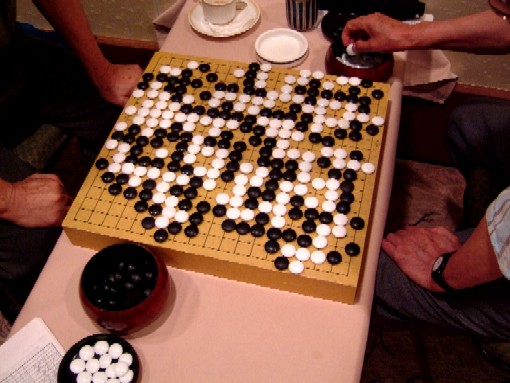
Let's get into the board and the rules. The board is a 19 by 19 grid. The thing that sets Go apart from other grid based games is the fact that the pieces (stones) are played on the places where the lines intersect, not in the squares the the grid forms. You can see a game in progress below.


Put simply Go is a battle to get the most area on the game board while loosing as few of your own stones as possible. You loose your stones when they are completely surrounded by the stones of your enemy. When that happens your enemy gets to take your stones and use them against you at the end of the game. That's basically it. Simple, right?

It is simple, but it can be extremely deep. To win the game you don't count the number of stones that you have down on the board you count the amount of area under the control of your stones. This means that you have to gain a lot of area by putting down only a few stones. On top of that you have to make sure the enemy can not sneak into your area and steal it from under your nose.

When both of the players can put down no further stones without either doing something illegal or making their area smaller the game goes into the end phase. In this phase you take the stones that you took from your enemy and fill in their area with them. They also do the same for your area. After all the stones are put down everyone counts how much area they have. The person with the most area is the winner. Below is a video that shows the whole process though quickly.


Any way, it is now time for the word of the day. Today's word is 囲碁(いご). It is pronounced igo and means Go. Way back when I used to be into Go, but I was never very good at it. I do like the feel of of slamming a stone down onto the game board though.

That's it for today. See you next time at JJNN.

Thursday, October 2, 2008

JJNN Thursday: Culture - 11

Welcome again to JJNN for Thursday October 2nd, 2008. Today we will be talking about the Japanese tradition of telling stories.

Everyone loves a good story. Weather it is in the form of a movie, the lyrics of a song, a book or a story passed on orally. In Japan there is a tradition of telling stories orally. They call this form of story telling rakugo. I have been to see rakugo many times and it is always a great experience. I could try to explain how rakugo works, but it would be easier to show an example. Take a look at the video below (rakugo performed in English).


As you can see there is one guy that sits on a cushion and tells the story. He says the lines of all the characters plus the narrator by changing his or her voice and changing the way he sits to represent the ways the characters act. There are hundreds of classic stories that most Japanese people know. The people that follow rakugo know most of these stories by heart. The story from the video is not one of the classic ones. It is set in modern day. A lot of the classic stories are set in the 1800s.

It is a very simple form of entertainment, but it does what it is suppose to do, entertain the masses. I always like a good rakugo. If you ever get the chance go out and see one. It is very much worth it.

Any way, it is now time for the word of the day. Today's word is 落語(らくご). It is pronounced rakugo and means rakugo. There are even some rakugo artists that star on a game show that airs every week. They have to tell jokes to earn points. That is always good entertainment as well.

That's it for today. See you next time at JJNN.

Thursday, September 25, 2008

JJNN Thursday: Culture - 10

Welcome again to JJNN for Thursday September 25th, 2008. Today we will be talking about yet another fall tradition in Japan.

There is nothing that most Japanese people like better than looking at nature. Sure, a lot of them never actually take the time to leave the city and venture out into the country side to actually see the nature first hand, but at least they can see it on TV. During this time of year a lot of Japanese people love to travel around the country and see the colorful fall leaves.

I have to agree. The fall colors are extremely beautiful. Japan is a very long country so people can enjoy the fall colors for over a month. There are even special maps that people can see at travel agents that show the best time to go to certain areas of Japan to see the best fall colors. An example of one of those maps from a few years ago can be seen below.


You can see that the earliest time that people can really see the fall colors is October 20th way up north in Hokkaido. The latest is around November 30th way down south. Of course it is going to be different in different places. This does not take mountains and valleys into account really. Well, now that we know when to look, let's see what we actually see. You can a leaf viewing video below.


Any way, it is now time for the word of the day. Today's word is 紅葉(もみじ). It is pronounced momiji and means leaves changing colors or Japanese maple. Two years ago around this time I went up to Aomori around this time of year. The leaves were really beautiful.

That's it for today. See you next time at JJNN.

Thursday, September 18, 2008

JJNN Thursday: Culture - 09

Welcome again to JJNN for Thursday September 18th, 2008. Today we will be talking about going to hot springs in Japan.

I am so happy that it is starting to get cool in the mornings and evenings. This is really my favorite time of year. A little hot during the day, but not too cold at night. Perfect really.

This time of year is (for me) the start of the hot spring season. There is nothing better than laying naked in a hot bath when the air around you is chilly. Especially if you had to go on a long hike to actually reach the hot spring. Also, if you can, drinking while taking a hot bath is great.

There are a couple of steps that you have to take to take a bath in a hot spring in Japan. The first one is probably the easiest one: finding a hot spring. Hot springs pop up like weeds in most places. Once you find your hot spring you take off your shoes and put them in a shoe locker. Take the key from the shoe locker to the front desk and pay for your hot spring experience.

At this point the person at the front desk will take your shoe locker key and give you a wrist band. The wrist band will have a number on it and a key hidden in it. You have to find your way to the changing area appropriate for your sex. Don't follow the colors because this could get you in trouble. Sometimes blue is on the female's door. Just watch to see who goes into what side.

After you get to the changing room find the locker that has the same number as the one on your wrist band. Use the key to open the locker. Get undressed and throw all your clothes into the locker. Use the smaller towel that the hot spring staff provides you with to hide what God gave you and lock up the locker.

Now it is time to get wet. Before you actually job into the hot spring you have to get clean. Yeah. I know it doesn't really make sense. You are going to the hot springs to get clean, but you have to get clean before you get in. This is because if you clean yourself with a shower before you enter the hot springs the water will remain clean longer. Plus, this is the way Japanese people take showers as well (they keep the same bath water for the whole family).

Now that you are clean it is time to get into the hot spring! At most of the hot spring places there are both inside and outside baths. Both of them are relaxing, but I think the outside ones are much better. Like I said before the cold air and the hot water is great. I love it when it is snowing while I am in the hot water. Plus, if you find a place with a good view, it makes the experience all the better. Watch the clip below and just think about being in one of those baths.


Depending on the hot spring you may get a robe to wear after you dry off and leave the baths. You can put it on and wander around the hot spring building. After you are done that you can get changed into your street clothes, hand in the towels and get your shoe box keep back. It always feels good to leave with that warm hot spring aura wrapped about my body.

Any way, it is now time for the word of the day. Today's word is 温泉(おんせん). It is pronounced onsen and means hot spring. I think maybe I will go to an onsen some time this weekend. It will be fun.

That's it for today. See you next time at JJNN.

Monday, September 15, 2008

jjnn monday: Science - 07

Welcome again to JJNN for Monday September 15th, 2008. Today we will be talking about the moon.

During this time of year in Japan everyone is looking up into the sky. They are looking to see the wonderful full moon that is up there at the moment. This time of year is called juugo no hi and it is the traditional start of fall in the old Japanese lunar calendar.

I love the moon. I used to go out at night and just lay down in my yard and look up at it and the rest of the sky for hours. Of course August was the best time to look at the moon because you could also see the perseids meteor shower at the same time.

Since we are on the subject of the moon here are a few random facts about the moon. The moon is about 380000 km from the earth. This is one light second so when we look up at the moon we are actually seeing as it was a second ago. Some evil alien race could be destroying the moon now and we would not even know it for another second. The name of the moon came from germanic word meaning month. We only actually see one side of the moon. This is because the moon's rotation was slowed and finally locked a long time ago. The far side of the moon is a lot more boring than the side that faces us because it is almost all white. If that side of the moon ended up facing us, we would not have grown up with any man in the moon (or in the case of the Japanese a rabbit that lives on the moon and makes mochi).

Any way, this leads to this article about the moon. Tokyo's science center known as the mirai-kan decided to hang up a copy of the moon so that everyone could see it even in the middle of the day. That's a great idea I thought. The made their 6.5 meter diameter moon out of 3000 panels of diodes. You can see a picture of it below.


They dimmed the diodes or made them brighter so they fit the NASA images of the moon. I would like to see this up close but today was the last day that it was on display. Maybe next year if they bring it out again.

I will leave you with this moon related clip.


Any way, it is now time for the word of the day. Today's word is 月(つき). It is pronounced tsuki and means to moon. You know I never could see a man in the moon. My pareidolia switch must be broken.

That's it for today. See you next time at JJNN.

Sunday, September 14, 2008

JJNN Sunday: Leftovers - 07

Welcome again to JJNN for Sunday September 14th, 2008. Today we will be talking about a dancing festival that takes place in Niigata.

Every year around this time of year in Niigata city (close to where I live) there is a dancing festival. The name of that festival is the Niigata sou-odori. In the festival dancers from all across Niigata come to give performances. This year there are 255 dance groups with over 12000 people dancing. The festival started yesterday and will go until tomorrow.

So, what kind of dancing can you see there? Anything from traditional dancing to hip hop and everything in between. Below you can see a picture of one of groups in more traditional costume.


Here is a compilation of what some of the dances look like. Most of these are more traditional.


The festival as it is now is based on a 300 year old festival called the Niigata Geta Sou-odori. In the original festival people would dance with geta (Japanese wooden shoes), lanterns and umbrellas. Seven years ago they decided to revive the festival in the way it is now. You can see an example of the dancing with wooden shoes below.


I can hardly dance with normal shoes on, so I personally think that is amazing.

Any way, it is now time for the word of the day. Today's word is 踊る(おどる). It is pronounced odoru and means to dance. I think that the only dance that I can actually dance is the chicken dance...

That's it for today. See you next time at JJNN.
Thursday, September 11, 2008

JJNN Thursday: Culture - 08

Welcome again to JJNN for Thursday September 11th, 2008. Today we will be taking about a food that is eaten in the fall in Japan.

I am so happy that it is getting cooler. Of course the fact that the temperature is going down means that it is getting into fall, but it also means something else in Japan. It means that it is time for yaki-imo! I love yaki-imo. It is a great hot treat on a long cold night.

So what is yaki-imo? Well it is just basically baked sweet potatoes. They either cook them on a grill or in a hole or even on hot rocks. Some times you can see families gather together fallen leaves in their yard so they can cook the sweet potatoes on the burning leaves. Yaki-imo is extremely simple to make and so good to eat. Here is a picture of some yaki-imo.


Looks good right? Well there is only one problem with yaki-imo. Well, besides the high calorie problem. It is the fact that these potatoes are sold off the back of trucks. That would normally be a good thing because you don't have to go all the way to a store to buy them, right? Well, I guess it is good, but these trucks have to do something to get every one's attention and let everyone know that they are in the area. Well, they do that with loudspeakers. Just check out the clip below.


This one actually starts to play music, but a lot of them don't (thank a deity for that one). They basically drive around the residential districts and yell over the loud speakers about how great and tasty their potatoes are. I don't know about you, but the more I hear that yelling the less I want to buy a potato and the more I want to throw a brick at the truck.

Any way, it is now time for the word of the day. Today's word is 芋(いも). It is pronounced imo and means potato. Being from Maine, I am legally under a binding contract to tell you to buy Maine potatoes. Boycott Idaho! (Just kidding!)

That's it for today. See you next time at JJNN.

Sunday, September 7, 2008

JJNN Sunday: Leftovers - 06

Welcome again to JJNN for Sunday September 7th, 2008. Today we will be taking about yakitori and random movies.

I have a lot of favorite Japanese foods. When asked I usually say sushi is my favorite because it is the one that I eat the most, but I think that yakitori is probably tied for first place. Yakitori has a special place in my heart because it is fast, cheap and goes well with any type of alcohol.

So, you may ask, what is yakitori? Yakitori is basically grilled chicken served on skewers. There are many different types of meat from all over the chicken (and sometimes other animals) grilled up in tasty ways. You can see a picture of a yakitori stand below.


Looks good, huh? I found a news story (it can be seen here) about a city in southern Japan called Kurume. Back in 2003 the people of Kureme found out that their city has the most yakitori stores per population in all of Japan. Ever since that fateful day they have held a "yakitori festival" once a year. This years festival started yesterday and goes on though today. If I could actually get there in time I would be heading there now. I can't imagine a better day than one I can walk around and eat lots of yakitori.

In other news, I found a random video while on youtube. What? "That's not news"? Well, yep, you're right. It's not news at all. But, I thought the video was cool so I decided I will post it any way. The name of the video is "Run!" and it is made by a person named Aoki Jun. All I got to say about this movie is that it is great! Take a look for yourself.


Aoki Jun also has other movies that he has made. This is his website. Most of them don't have any Japanese in them so they are good to watch for anyone. Enjoy them.

Any way, it is now time for the word of the day. Today's word is 焼き鳥(焼き鳥). It is pronounced yakitori and means yakitori. Yaki means bake or grill and tori means chicken. Finally a name that makes sense.

That's it for today. See you next time at JJNN.

Thursday, September 4, 2008

JJNN Thursday: Culture - 07

Welcome again to JJNN for Thursday September 4th, 2008. Today we will be taking about a type of summer festival.

There are many different types of festivals in Japan. These festivals range from the "normal" festivals in which people pull around portable shrines to the "wild" festivals which always seem to involve either fireworks or fire of some kind. I am going to talk about one summer festival that goes on in the Niigata prefecture city of Shirone (now part of Niigata city).

The Shirone festival is actually more of a battle. They don't use knives or even swords in their battle though. Their weapons are much bigger. You can see a picture of the weapon below.


Yep. That's a huge kite. The Shirone summer festival is a huge kite battle. There is a river down the middle of Shirone, and every year in June two teams come together to fight each other over the river. It doesn't really matter who wins. All that matters is that everyone has a good time. You can see what this kite battle looks like below.


You have probably heard of kite battles in which the teams try to snap the ropes of the opposing team. Something like that happens in this battle as well. But, that is not the only way to down your opponent. The kites that are used for this battle are so huge that they need a lot of moving air to stay aloft. Most teams just position themselves in front of their opponent so they block the wind. Simple and effective.

I took part in this festival years back. I remember that it was a whole lot of running. You have to make sure you hold on tight to the rope because a sudden wind could yank it out of your hand. Also, you have to be sure not to get in the way of any rope that is being pulled tight. That could lead to an injury, a missing limb or even death. If you keep that in mind though it is a fun festival and worth going to see sometime.

Any way, it is now time for the word of the day. Today's word is 凧(たこ). It is pronounced tako and means kite. I haven't flown a normal sized kite in years. Maybe I should buy one and go to the beach to take it for a spin.

That's it for today. See you next time at JJNN.

Thursday, August 28, 2008

JJNN Thursday: Culture - 06

Welcome again to JJNN for Thursday August 28th, 2008. Today we will be taking about dialects from around Japan.

Japan has a lot of different dialects. The dialects range from those are almost like normal Japanese (the Japanese spoken in Tokyo) and those that almost seem nothing like Japanese. I call the dialect from my city the "gaa" dialect. People just seem to sprinkle the word "gaa" randomly in their sentences. It can be interesting to listen to, but I don't think I will ever be able to speak fluently in it because it is just too random. Maybe there is just some grand "gaa" pattern that I am missing.

The most famous Japanese dialect is that dialect from around Kyoto and Osaka. Many people from even around here like use that dialect. Many comedians in Japan come from the area around Osaka, so people that can use that dialect are automatically funny in some way or another. The person in the clip below will teach you a little Osaka dialect. Notice how it is different from the normal Japanese.


Another of the the category of hard dialects to understand is Akita dialect. Akita is a prefecture in northern Japan. It is It is north of Niigata and located on the sea of Japan. I found a news story about Akita dialect. You can see the original story here.

It seems that the people of Akita prefecture wanted their new foreign teachers of language to learn about Akita dialect. Eight foreigners from 4 different countries were made to take a class to learn the dialect. All the students said they were so surprised that Akita spoke such a different from of Japanese. They said that it was almost like a different language. Others said that it felt like a warm dialect and they liked it.

I want to give you an example of what Akita dialect sounds like. Below is the opening of an anime called ndagarasha. The anime is based in Akita and is all in Akita dialect. There are two subtitles at the bottom. The top subtitle is what the music is saying (in Akita dialect) and the bottom subtitle is normal Japanese. I love the fact that they have to subtitle their anime so normal Japanese people can understand it. Any way, enjoy:


Any way, it is now time for the word of the day. Today's word is 方言(ほうげん). It is pronounced hougen and means dialect. I think there must be more variety in the dialects of Japan compared to the dialects of America.

That's it for today. See you next time at JJNN.

Thursday, August 21, 2008

JJNN Thursday: Culture - 04

Welcome again to JJNN for Thursday August 21st, 2008. Today we will be taking about my favorite Japanese food.

There are a lot of different foods in Japan. Not only are their Japanese takes on foreign foods like curry (Japanese curry is not really curry), but there is food that is original to Japan. One of my favorite Japanese foods is sushi. In this day an age I think that everyone knows what sushi is. It has become very popular in even the most rural parts of America (AKA where I am from) and I assume that it has really taken off in almost every other country.

There are two types of sushi restaurants in Japan. The first type (and the most inexpensive) is the rotating sushi restaurant. I guess with a name like that it sounds like the restaurant itself is spinning around, but only the sushi really is actually doing the spinning. You can see an example of one of these restaurants below:


If only those little subtitles actually spun around with the sushi! Sometimes you get a little surprise because a lot of the cuts of fish can look a lot alike. so, here is how one of these restaurants actually works. You go and sit down at the counter and watch all the sushi file by. When you see something that catches your eye you take it off the belt (be sure to take the plate!).

After you are done eating the sushi pile up your empty plates. You will notice that the different types of sushi are on different plates. That is because the color and design of the plates represent how expensive the sushi is. When you are done eating and ask for the check the waitress will come over and make a note of how many of each type of plate you have. That will be your bill.

I love this type of sushi restaurant because it is simple and fast. You can grab the sushi off the conveyor belt or just order what you want from the menu. I usually go to this type of restaurant once a week. This week I think I ended up going 3 times. When you find a good thing it is hard to give it up, right?

The second type of sushi restaurant is a sushi bar. This type of restaurant can get very expensive, but the sushi is of a better quality and the service is usually wonderful. It is a "special occasion" type of place to eat. Below is a Japanese comedy show about eating at a sushi bar. Keep in mind that most of it are jokes, and enjoy.


Oh to to to to...

Ma ma ma ma ma...

By the way, the salt that is left outside the door of the sushi bar (it is not left in all places) is actually from an old Japanese superstition that says salt purifies and keeps out the bad spirits. I wouldn't recommend eating of it unless you want to make the owner of the building mad.

Any way, it is now time for the word of the day. Today's word is 握り(にぎり). It is pronounced nigiri and means nigiri. Nigiri is one of the 3 major types of sushi. Nigiri has a big cut of fish (or something) on top of rice that has been formed into a specific shape. The other two types of sushi are maki and gunkan. Maki means the nori (seaweed) is wrapped along the outside to make a long thin roll that is usually cut into 6 pieces. Gunkan is hard to explain so I will just show a picture.


There is also te-maki in which the maki sushi is rolled loosely by hand (I don't consider this a major group of sushi)

That's it for today. See you next time at JJNN.

Thursday, July 24, 2008

JJNN thursday: Culture - 03

Welcome again to JJNN for Thursday July 24th, 2008. Today we will be taking about how hot it is out there.
Yes folks, it's hot. And on top of that it's humid. A dastardly combination that I have come to hate. So what do you do when it is really hot? Do you sit under your air conditioner and drink cold iced tea? Do you go and take a cold shower? Do you set up a tent in front of your refrigerator with the door open? To me, those sound like very good things to do when it's hot.
As it turns out in Japan it is not quite the same. The Japanese (at least the ones around where I live) like to sweat when it is really hot. They will eat a really spicy curry or drink some hot coffee. That makes no sense to me what so ever. Personally, I try to avoid sweating in front of people at all costs. But, maybe that is just me.

The Japanese also like to eat eel when it gets really hot. There is a special time of the year, which happens to start today, on which lots of Japanese people eat eel. The name of this special day is doyou ushi no hi. I don't think I will be running out for some eel, but if I happen to get some I will still eat it.

It turns out that are 4 doyou a year
. Doyou are the traditional last 18 days of a season. You many be wondering why it is called Doyou? Well, it's actually rather interesting. All of the seasons traditionally have one of the 5 elements associated with it. Spring is wood, summer is fire, fall is metal, and winter is water. Wait a sec! 4 seasons and 5 traditional elements. What about the 5th element? Well, as you probably have already guessed, that 5th element is earth. But, where does earth go? Earth's place ends up being at the last 18 days of every season. That way all the elements are separated nicely and earth gets to play a role. The word doyou means dealing with the earth. This year the summer doyou is from July 24th to August 5th. 

Well, that's all well and good, but what does that have to do with eel, right? Actually, nothing. The fact that one traditional season is ending has nothing to do with eel. So, why do Japanese people eat eel on doyou no ushi no hi? That is a good question. There are many answers to that question, but the one most people believe is the story about a person that was running a failing eel restaurant hundreds of years ago. The restaurant owner went to this person named Hiraga Gennai with his problem. Gennai thought about it for a second and remembered a folk story he once heard that said if you eat food that starts with u on ushi no hi you will never look to the heat of summer. It just so happens that in Japanese eel is called unagi. Gennai told the man to put a sign into his window that says that it is ushi no hi and the customers poured in. Marketing genius! Ever since than Japanese people have been eating eel during the summer time. You can see a picture of what people eat below. 
There is one problem with that this year. It turns out that the price of a nice eel meal is going up. One meal like that has gone up over 200 yen in most places. There are many reasons why the prices are going up. The most pressing one is because of the fuel prices of the boats that get the eels. And than, of course, there is the fact that they have been over catching eels for a long time and we are starting to run out of them. 

Any way, it is now time for the word of the day. Today's word is 鰻(うなぎ). It is pronounced unagi and means eel. I remember the first time that actually ate the Japanese eel. Everyone was saying it was so good, but I really didn't want to eat anything that looked like a snake. When I finally did try it I found out everyone was right and it was very good. Goes to show you that you just shouldn't be picky about trying new foods. Mmmm... monkey brains.

That's it for today. See you next time at JJNN.

Thursday, July 17, 2008

JJNN Thursday: Culture - 02

Welcome again to JJNN for Thursday July 16th, 2008. Today I will be looking at Japanese culture though the looking glass of schools.

Today I want to talk a little bit about the education system in Japan. I always like to talk about education in Japan because I have been dealing with the education system here in Japan for years. Sure I am not a full fledged teacher, but because of that I have been to many schools and was able to learn a lot about how teachers and students think.

So, first comes the question about the differences between schools in Japan and schools in other countries. I am from America and I know the American system so when I make comparisons it will be to American schools. Feel free to leave a comment if you are from another country and say how it works in your country. Also, I am going to skip pre-school in this post, because I still can't quite figure it out because different kids can start pre-school at different ages. Elementary school starts at about age 5 and goes for 6 years. That is a year longer than in America. Jr. High School is 3 years long. As soon as students graduate Jr. High they are done with the education that they legally have to take. Not a lot of people drop out after the Jr. High graduation, but it does happen. High school is only three years in Japan. A year less than in America, but if you do the math it adds up to the same number of years.

The basic classes in Elementary and Jr. High School are gym/health education, math (arithmetic for elementary school), home economics, music, art and industrial arts, science, Japanese, and social studies. In Jr. high the kids also have English as a subject. There are two special subjects that are in both schools. These are the moral education class and integrated studies. Personally I am of the opinion that normal people do not need a school subject to learn morals, but I guess it never hearts, right? The integrated studies class is one in which the students have to use information they have learned in all of their subjects to think about things like environmental problems, handicapped people, and other such things. Also, English education for Elementary schools fall into the integrated studies class because they have to think about other cultures using the information from everything they have learned so far (that and it doesn't fit any other type of category heading).

I spend most of my time in Jr. High school so I want to talk about that for a little while. Every day there is homeroom in the morning and in the evening. The style of the homeroom depends on the teacher, but it is usually run by the students. They do things like report on the schedule for the day and check the general help of the students. Because of the large class size (this depends on the school, but at mine the number of students in one class gets up to 35 or so) the homeroom is really needed. Also, depending on the school, the students all have to read a book for 5 to 10 minutes every morning. Every Monday when I go to my Jr. high school we also do and English broadcast so the students can practice their English listening.

After the morning homeroom and other morning activities there are 4 classes that are 50 minutes long (sometimes they are only 45 minutes long, but this can be rare). After the 4 classes it is lunch time. In most schools there is no cafeteria so the students eat in their class room. Also, the students take turns passing out food to the other students. The homeroom teacher usually eats with the students. After the students eat the students clean up the area and take an hour or so off to play in the gym or in their class room. After that they clean the school. Yep, the students are the one that clean the schools in Japan. And, mostly, the teachers watch over them like hawks to make sure they do a good job at it. After that there is either one or two afternoon class and then the afternoon homeroom. After that the students usually go to club activities for hours on end and than finally go home or go to cram schools to study more.

A lot of kids go to cram schools in Japan. You may be asking yourself why a normal healthy kid would want to study more after school. That is a good question, but there is a good answer. In most schools there is no automatic movement from Jr. High School to High School. That is because kids in Japan do not have to go to High school. This means that all the High Schools give entrance exams. If you fail the exam to a school that you want to go to, you can not go to that school. That drives some kids to study hard, but it drives the parents of all kids to make their kids study hard. The competition for High Schools and Universities (especially the privet ones) is intense. There are students that fail the exam and refuse to give up on a particular school (or they fail all of their entrance exams) so they are stuck in the system for a year until the next round of exams. They call those students "ronin." Ronin used to mean a samurai with no master, or a wandering samurai, but now it refers to those students.

There are a lot of other minor differences. For one, the students never move unless they have to go to a special class room like the science room or the home economics room. The teachers go to the students. The students all have inside and outside shoes. This makes it a long ordeal to move the kids outside for gym or some other reason. It is also very rare for a teacher to stay in the same grade every year. Normally they are moved around to go with the students or to fit a certain need. The teachers also change schools ever 3 to 7 years. The teachers are employed by the government of an area, not by the schools.

I could go on, but I am going to leave it at this. Let me know if you have any questions.

Any way, it is now time for the word of the day. Today's word is 学校(がっこう). It is pronounced gakkou and means school. I like teaching in Japanese schools. A day spent teaching at a school is much better than a day spent sitting in my office and staring at the wall across the room.

That's it for today. See you next time at JJNN.