Showing posts with label technology. Show all posts

Friday, February 27, 2009

JJNN: Earth Simulator 2

Welcome again to JJNN for February 26th, 2009. Today I will be talking about a new Japanese super computer.

You know, I love the idea of super computers. If you close your eyes and think about a super computer what do you think about? For some people it is probably HAL from 2001 a Space Odyssey or maybe you think about rows upon rows of computer banks with magnetic tape recording and readouts. I guess I am in the camp of the second way of thinking. It may be a little out dated, but it is just cool.

The first super computer I have ever heard about was the Japanese super computer the Earth Simulator. It was the fastest super computer in the world from 2002 to 2004. It was made to simulate the effects of global warming on a grand scale. It was really amazing for its time, but it was huge. All in all, the Earth Simulator 640 nodes (individual computers). Each node had 16 processors and 16 Gb of memory. Two of the individual computers were put in the same case and each case consumed 20 kW of power. That means the total power consumption was 6400 kW. Ouch. But, on the bright side, a lot of calculations could be performed per second. The number of calculations a computer can perform per second is called a FLOPS (Floating point Operation Per Second). How many could the original Earth Simulator perform? 35.86 * 10^12 FLOPS. That's right, almost 36 trillion operations per second. That used to be the fastest computer in the world, but now it is a mere 72nd place.

Here is where the big news comes in. You can find the original article here. The company that made the first Earth Simulator, the Japanese Agency for Marine-Earth Science and Technology (JAMSTEC), is coming back to make an Earth Simulator 2. This is going to be leaner and more powerful than the first Earth Simulator. Instead of the 640 nodes of the first one, there will be only 160 nodes. Each node will be much more powerful than the nodes in the first Earth Simulator. Because there are fewer computer the amount of energy used it reduced. In fact JAMSTEC said the power usage should go down by as much as 80%. But, the most important thing is how many FLOPS is can perform. The new Earth Simulator can perform 131 * 10^12 FLOPS. That would be a whole lot. The only thing is, it is not the fastest in the world. The fastest super computer is the IBM Roadrunner with a whopping 1105 *10^12 FLOPS.

I will leave you a picture of the new Earth Simulator.

Friday, January 23, 2009

JJNN Friday: Technology - 14

Welcome again to JJNN for Friday January 23rd, 2009. Today we will be talking about the successful launch of the H2A rocket.

Long gone is the time when people gather around their television sets to see the launch of a rocket bound for space. You can't get people away from their TV sets if the rocket is one that is used for war and it is heading for someplace where people live. Of course that makes sense. When there is lives on the line people are always willing watch. When it is just a lot of money and scientific knowledge that is on the line, it is hard to find people that care. I guess this is just the way things are. It has been like that ever since people got used to the idea of people riding rockets to the moon (AKA, people figured out that it is mostly safe). I just hope some day that people get excited by the prospect of gaining knew knowledge. Maybe that will never happen, but I guess I can wish that it will come.

Any way, on to the news. According to this article, Japan launched a rocket today with a payload of 8 small satellites that each have different uses and are all provided by different universities and companies. The name of the rocket they use is the H2A. The H2A rocket is made by the Mitsubishi company and with the latest rocket they are up to number 15. This successful launch is also the 9th successful launch in a row for this type of rocket. The first launch of the H2A took place in 2001. The 6th launch in 2003 was a failure. Rather than go into a lot of specific details about the rocket that can be looked up anywhere I want to show you what one of these launches actually looks like. Enjoy the clip below.


Looks great, doesn't it?

The latest rocket has 8 different satellites. Here is a list of what they are called, who made them and what they should do. The list (as almost all of my lists) is in no specific order.

1) SDS-1: SDS stands for Small Demonstration Satellite. Made by JAXA (think of JAXA as the NASA for Japan). It is going to be used to gain data for a program that studies small satellites.

2) SPRITE-SAT: Made by Tohoku University. This satellite has many different pieces of data taking equipment. It can do things like check the weather in the area of Earth below it and even has a detector for the high energy gamma rays given off by lightning.

3) Maido 1: Made by Astro-Technology SOHLA. This satellite is used to help collect data that could be used later to model electric storms.

4) Ibuki: Made by JAXA. Also know as GOSAT, this satellite is going to be use to monitor the level of CO2 and other greenhouse gasses like methane in the Earth's atmosphere.

5) Kagayaki. Made by Soran. This satellite is being used by the company to help out kids with bad illnesses. They can get their dream of piloting something in space from their hospital bed. It is really touching.

6) KKS—1: Made by Tokyo Metropolitan College of Industrial Technology.

7) STARS: Made by Kanagawa University.

8) PRISM: Made by Tokyo University.

I could not find a lot of information on the last few because they are used in private research projects. If anyone else find out anything about these satellites please let me know.

Any way, it is now time for the word of the day. Today's word is 打ち上げ(うちあげ). It is pronounced uchiage and means launch. Someday I want to go to one of these rocket launches.

That's it for today. See you next time at JJNN.

Sunday, October 26, 2008

JJNN Sunday: Leftovers - 12

Welcome again to JJNN for Sunday October 26th, 2008. Today we will be talking about a new type of future fashion.

There are a lot of strange types of fashion out there. If you have ever been to Harajuku on Sunday morning you have seen most of them. Of course there are always people looking out for the next thing that might be a fashion trend. Where is the best place to look? Normally people wouldn't think that fashion makers would be looking towards science for their fashion ideas, but in this case they did.

Last week I talked a little about a guy named Mr. Shimamura who got his nobel prize from the isolation a glowing protein from jellyfish. A Japanese company decided to use this type of protein to make silk. This silk has the special property that it can be seen to glow if looked at though specific filters. The company has even used coral to produce the colors of red and orange along with the original color of green. You can see what this silk looks like when seen though a filter below.


The team that is working on producing more colors and types says that it wants to see this type of silk used normally in fashion within the next 5 years. I don't know if this will make a new type of fashion or just set fashion back to the 80's when just about everything glowed. I think it is time to be scared...very scared.

Any way, it is now time for the word of the day. Today's word is 光(ひかり). It is pronounced hikari and means light. Always look on the lighter side of your life...

That's it for today. See you next time at JJNN.

Friday, October 24, 2008

JJNN Friday: Technology - 13

Welcome again to JJNN for Friday October 24th, 2008. Today we will be talking about what can happen when you divorce someone online.

Love comes in many forms. There is the love between parents and children, the love between siblings, the love that only lovers know, and of course there is the love that can be felt for people you meet online. This story has to do with that last kind of love. Actually, it is more about what happens when online love goes wrong.

In Japan there are a lot of online role playing games. One of the most popular ones is called Maple Story. The thing that makes it popular is the fact that you can play it for free. People from all ages and walks of life flock to play Maple Story. In the game you and your friends go out and try to defeat monsters. You can talk to people in the game and work together. The only problem is that some people get into the game too much and actually fall in love with the people on the other side of the character they are speaking with. Oh, by the way, you can see a picture of Maple Story below.


The news story that I want to talk about this time is what happens when love on the internet goes bad. Like any good love story I guess I should start from the beginning. This love story starts with two people, a 43 year old lady named Mayumi from southern Japan and a 33 year old guy from northern Japan. They were both very into Maple Story. They met somehow and ended up falling in love. They eventually decided to get married. I am not talking about a real world wedding here. I am talking about getting married within the game. Not quite normal or legally binding.

The only problem was that things do no end "happily ever after." Something happened to cause the online husband to want a divorce. The thing is, they were not actually married so he just said something like "We are now divorced." That made Mayumi angry. What do you think she did at this point? Well, she ended up doing the equivalent of online murder. She knew her "ex-husband's" password so she used it to go in and erase his character. Very simple and a lot less bloody than actual murder.

The only problem with this online murder (besides the fact that is a psycho thing to do in the first place) is the it is also against the law. No, we are not talking about murder 1 here. We are talking about a law about unauthorized access to computer accounts. Under this law, if Mayumi gets convicted, she can get up to a year in jail or a fine of up to 500000 yen (about 5000 USD). Again, not as bad as the sentence for an actual murder.

Any way, it is now time for the word of the day. Today's word is 離婚(りこん). It is pronounced rikon and means divorce. Why would anyone bother with an online divorce. You could just go off line.

That's it for today. See you next time at JJNN.

Monday, October 20, 2008

JJNN Monday: Science - 11

Welcome again to JJNN for Monday October 20th, 2008. Today we will be talking about something that will help me get though the winter.

I know know if it is getting cold where you guys are, but I can tell you that in the morning at night here it is really getting cold where I am. It has gotten to the point where I want to get out my heaters and turn them up to high. I say "heaters" because Japan does not believe in central heating. I always joke with my friends saying that the warmest room in my house during the middle of the winter is my refrigerator. That means that there are only so many ways to survive the winter in a old drafty house like mine. The first way so to drag out a lot of heaters and turn them all up onto high. Another way to survive the winter is to spend the whole winter under a kotatsu. A kotatsu is a table with a blanket around its edges and a heater on the bottom. You can see a picture of a kotatsu below.


I love kotatsu, but once you sit under a kotatsu, you never want to leave. I have spent many a lazy winter weekend not leaving the house because I was comfortable sitting under the kotatsu. I have even spent many a night sleeping under the kotatsu as well. A lot of Japanese people say that you will catch a cold if you sleep under a kotatsu, but I have never gotten a cold because of that.

Another thing that helps people in Japan get though the winter is Japan is called a kairo. Kairo are little bags of chemicals that suck in oxygen and go though a chemical reaction that releases heat. The actual chemical reaction is

Fe + (3/4)O2 + (3/2)H2O -> Fe(OH)3 + 96 Kcal/mol

In other words powdered iron reacts with oxygen from the area and water vapor that is also in the area and produces Ferric (III) Iron Hydroxide (AKA rust) and some energy. This energy is in the form of heat and it makes everyone happy on a cold winter night.

The only problem with these kairo is the fact that they only last for so long. Sure the reaction could last up to eight hours depending on the amount of iron powder in the kairo. After the reaction is done with there is no way to change the rust back into iron, so the kairo has to be thrown away. These things were made to be disposable, but that is not very environmentally friendly, is it?

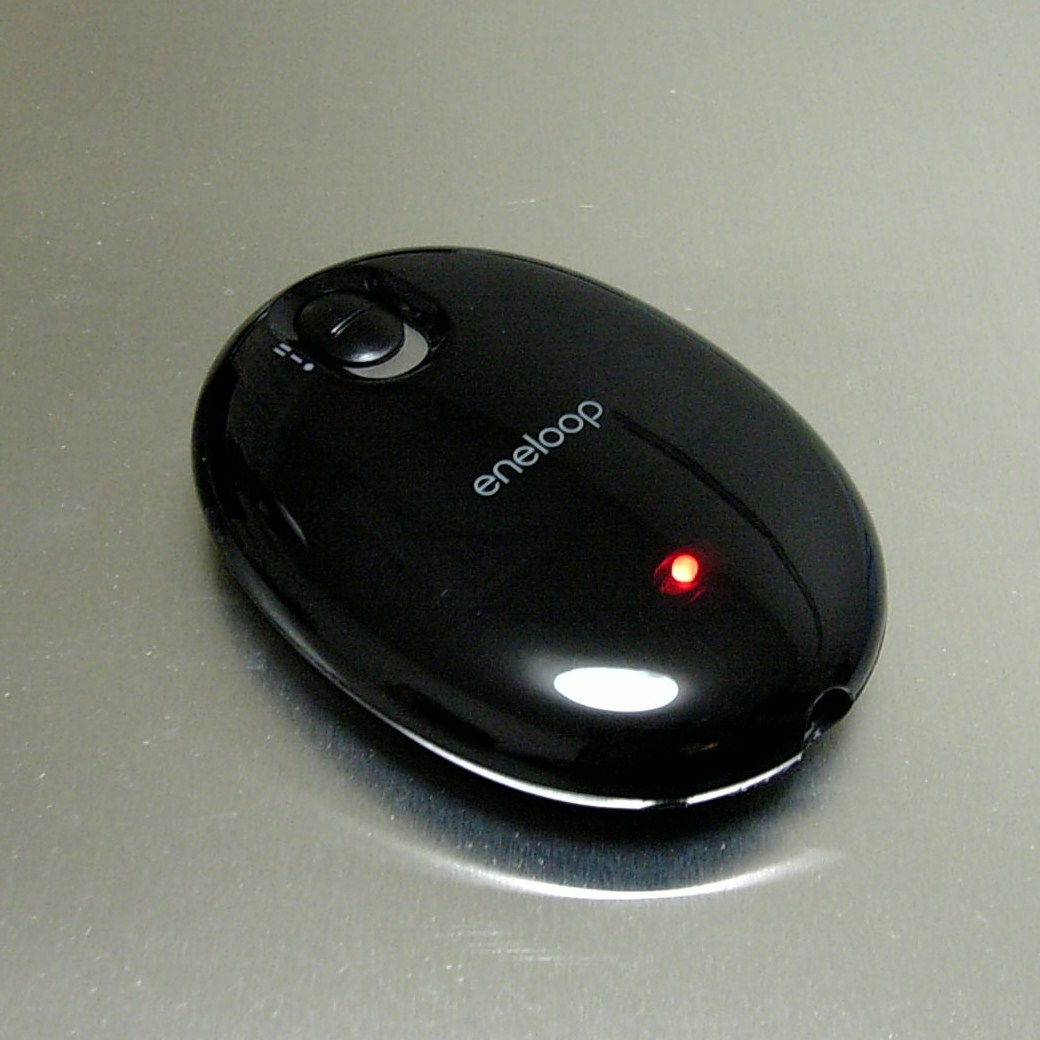
That is where Sanyo Electronics comes in. Sanyo wanted to find a way to get just as much heat, but also be more environmentally friendly. They ended up coming up with a new type of electric kairo called the eneloop kairo. Eneloop stands for Energy Loop. You can see the kairo below.


It looks sort of like a mouse, doesn't it? The eneloop kairo uses two rechargeable double A batteries. It can be used up to 5 hours on 4 and a half hours of charging. It is also said that it can be charged up to 1000 times without having to change the batteries at all. When the batteries do finally fail, they just need to be switched out and the kairo can be used again. This thing will definitely help me though the winter.

As with all things, there is a down side. The first downside I can see is the wait. With the traditional kairo, when one runs out all you have to do is open another package and you got instant heat, but with this you have to wait for it to change for it to be used again. That means there is a significant wait between uses. The second downside can be seen if you look at the kairo from an ecological point of view. Sure you will no longer be throwing away old kairo (basically rust and a little cloth), but ever 1000 days (3 years of constant use...but who would use a kairo in the summer?) you have to throw away 2 batteries. The batteries contain heavy metals and are very bad for the environment. In the long run I wonder if these things are very ecologically friendly or not.

Any way, it is now time for the word of the day. Today's word is 懐炉(かいろ). It is pronounced kairo and kairo (sometimes translated as "hand warmer" even though it can be used for any part of the body now days). I sort of like the old kairo that you stick to the inside of your shirt. Those keep you warm all day. Some times the kairo react strongly and become really hot.

That's it for today. See you next time at JJNN.

Friday, October 17, 2008

JJNN Friday: Technology - 12

Welcome again to JJNN for Friday October 17th, 2008. Today we will be talking about ROBO JAPAN 2008.

When I went to Tokyo for the Tokyo Game Show I stayed in a place called Yokohama. Yokohama is a very nice place. On the last day that I was in Yokohama I was wandering though a giant mall and I came upon a sign that said simply ROBO JAPAN 2008. Needless to say that really got my attention. I was thinking of staying there and checking it out, but my friends called me to the TGS, so that was off the list.

ROBO JAPAN 2008 was a huge robot festival. It included 45 different companies that brought over 100 different robots. Among these robots was the world's smallest robot. This robot walks on 2 feet and is only 3.4 cm (just over an inch) tall. A lot of people came to see all of the robots that were in the festival. The most famous robot at the festival was ASIMO. You can see a video of ASIMO and everything it can do below.


ASIMO looks a bit creepy when it is running.

Any way, it is now time for the word of the day. Today's word is 走る(はしる). It is pronounced hashiru and means run. The elementary school kids that I teach always find a way to make me run when I don't want to. Bah.

That's it for today. See you next time at JJNN.

Friday, October 10, 2008

JJNN Friday: Technology - 11

Welcome again to JJNN for Friday October 10th, 2008. Today we will be talking about the future here now.

I watched a lot of movies when I was young. Everything from Ghostbusters to Gremlins. There was always one movie that stood out to me though, Robocop. I always thought it would be cool to have my brain put into a robot. All the long life and power of the robot with the brains of the human. Perfect really.

Well, according to this story, we are taking a step closer to that dream. No, we are not taking brains and putting them in machines. We are taking whole humans and building a robotic suit around them. I know the idea is closer to Gizmo Duck from the Disney cartoon than Robocop, but I still like Robocop better.

A Japanese company called Cyberdyne (cool name, huh?) has produced their own version of a robotic suit called HAL. The name of the company seems to be a throwback to a company name in Terminator and the name of the suit seems to be a throwback to the name of the computer in 2001: A Space Odyssey. HAL actually stands for Hybrid Assistive Limb. They named it that because they designed this robotic suit to help people who have trouble walking or moving otherwise. You can see a picture of HAL below.


The version of HAL in the picture is the full body version. There is also another version that is just the bottom half of the suit. That other version is geared towards those whole have trouble or have lost the ability to walk only. Personally, if I am going to get a robotic suit, I think I would get the full body version. You can see HAL at work in the video below.


That is an old video, but the maker of HAL has constantly been upgrading HAL ever since. The big news on the HAL front is the fact that are not selling the robots. That's right! You can buy one of robots and walk around like that now. How much do you think these things cost? Well, let me tell you that it is not cheap. A one leg version of the suit comes with a price tag of 150000 yen (a the current sucky market prices just about 1500 USD) a month! The two legged version is 220000 yen (about 2200 USD) a month. That is for a 5 year lease. My wallet says ouch.

Any way, it is now time for the word of the day. Today's word is ロボット(ろぼっと). It is pronounced robotto and means robot. And, yes, domo arigatou mr. roboto.

That's it for today. See you next time at JJNN.

Friday, October 3, 2008

JJNN Friday: Technology - 10

Welcome again to JJNN for Friday October 3rd, 2008. Today we will be talking about the end of an era.

When you think about computer storage what do you think about? Do you think about huge hard drives? Do you think about USB flash memory drives? Do you think of DVDs or CDs? What about before all those things? No I am not talking about cassette drives. That is going way to far back. I am talking about those little 3.5 inch disks. I mean just look at it...


Doesn't just looking at it bring back memories? I mean I can remember having to deal with stacks of those things to install large games in the days before CDs made things easy. One game that I always played way back in the day took 14 disks to install. Though after CDs came out I always used my old 3.5 disks to practice for card throwing. They were just heavy enough to help with accuracy without being too heavy and hurting the wrist.

Any way, now that I brought you on a trip down memory road, I have some bad news. I was a little shocked to read this. Apparently Mitsubishi (one of the largest producers of 3.5 disks in Japan) is going to stop producing these disks in March of next year. This is more than likely going to be the final blow to this technology. Though many have seen this coming for many years it is still a little sad. Even though I say that none of my computers actually have a 3.5 disk drive...

Any way, it is now time for the word of the day. Today's word is 消滅(しょうめつ). It is pronounced shoumetsu and means termination. I guess I never really felt the same feelings for the 5.25 inch disk as the 3.5 inch disk.

That's it for today. See you next time at JJNN.

Friday, September 26, 2008

JJNN Friday: Technology - 09

Welcome again to JJNN for Friday September 26th, 2008. Today we will be talking about a new Japanese robot.

There are a lot of robots made in Japan. There are robots that do everything from putting cars together to dancing traditional dances. Sure, the ones that put the cars together actually do something that is useful, but even the ones that do things like dance teach the engineers that make the robots a lot about how to make new types of robots. Even the most useless robot can end up being useful.

The newest of the robots that does not really seem useful is called Seiko-chan. This robot can do something I could never do, it can ride a unicycle. I never really wished I could ride a unicycle, but now I don't want to loose to a robot. Maybe I should learn. You can see this new robot in the video below.


Like it says in the video, the robot has advanced sensors and a balance system. It is by trying to advance those sensors and systems as well as making the robot better in general that the robot industry in Japan jumps forward compared to the robot industry in other countries.

Seiko-chan is suppose to be the cousin of an earlier robot invention named Seisaku-kun. This robot rides around on a bike. Like Seiko-chan he keeps balanced and moves according to advanced sensors. You can see what he can do down below.


I don't think I could get up a slope that steep on my bike.

Any way, it is now time for the word of the day. Today's word is 一輪車(いちりんしゃ). It is pronounced ichirinsha and means unicycle. To become an elementary school teacher in Japan you have to know how to ride a unicycle. It is on the test to become a teacher.

That's it for today. See you next time at JJNN.

Sunday, September 21, 2008

JJNN Sunday: Leftovers - 08

Welcome again to JJNN for Sunday September 21st, 2008. Today we will be talking about ecologically minded power companies.

Well, first thing is first I guess. The one or two people that actually read my blog probably noticed that I didn't post anything yesterday. I was a little busy and I decided to take a break from pseudoscience for this week. Worry not, though, because it will be back next week in full force.

Today I found a nice technological article about solar power being used by big Japanese electric companies. You can see the original article here. I am so happy that these electric companies have finally gotten onto the ball about this.

I did a little post about solar power back in the beginning of July, but I never did say anything about how solar power works. So, before I actually get into the new story, I want to talk about what makes solar power work. There are actually a couple of different types of solar power. One form uses the a lot of curved mirrors to focus the light from the sun onto a tower. The water in that tower is made to boil because of the concentrated heat from the sun and that steam moves a turbine which makes electricity. That type of solar power is not what I am referring to though. I am talking about the solar power obtained by solar panels (also called photovoltaic cells).

Solar panels work though what is called the photoelectric effect. Basically what happens is some lights hits the surface of a material (it does not have to be a metal or a semi-conductor) and an electron is released from that material. Why are the electrons released? Well think of it this way; electrons are held in place in the material by an attraction to its positively charged nuclear core. If something comes in that is stronger than its attraction to it's core, it will be knocked away and be free to leave the material. The attraction between the electron and the core can be expressed in the form of an energy, but so can light (some types of light are more energetic than others). So this means if the light has more energy than the electron's connection to its core the light will knock the electron free.

That all happens for only one atom, but solar cells are made up of billions of atoms. This means that if light with enough energy is coming in a lot of electrons are leaving their atoms. These electrons are made to flow and like magic we have energy from a solar cell. Scientists are working hard to find new materials in which the electron is not bound strongly to its nuclear core. When these materials are found the effectiveness of solar panels will go up and they will produce more electricity.

Now, with that out of the way, I can talk about the news story. Two of the biggest energy providers in Japan, Tokyo Denryoku and Kansai Denryoku, made a promise that they will be using solar power to power about 40000 homes a year by 2020. This is a huge change in their normal practices of using fossil fuels to create electricity. They say they are converting 30 places into solar power factories and plan on producing about 40000 kilowatt hours a year. According to their sources this will keep about 70000 tons of CO2 out of the air.

But, wait, there's more. Not only are they making the solar power plants, but they decided that they should be riding around in electric cars. They are going to buy 10000 new solar powered cars along with other types of electric cars. This will make up just about a third of their fleet when they do get the cars. Every little bit helps. You can see one of these electric cars below.


Ugly is not the word I am looking for, but it's close.

Any way, it is now time for the word of the day. Today's word is 電気(でんき). It is pronounced denki and means electricity. I wonder why a lot of people never think to put solar panels on their roofs? Sure they cost some money to install, but they pay back a lot in the long run.

That's it for today. See you next time at JJNN.

Friday, September 19, 2008

JJNN Friday: Technology - 08

Welcome again to JJNN for Friday September 19th, 2008. Today we will be talking about elevators that have the right stuff.

Ever want to go into space but don't want to deal with all the forces caused by rockets? Well according to this article, you may be able to do that yet. A team of people in Japan are proposing that we build an elevator into space. Yep, you read that right. An elevator where someone can literally say "The next stop is Earth orbit."

So, how does this all work? Well first thing is first. You need top floor for the elevator. Scientists decided that for everything to remained balanced they would have to string the cable from a satellite that is in geosynchronous Earth orbit (i.e. always over the same spot on the earth no matter what). This satellite will be about 36000 km (22000 miles) from the surface of the Earth. The top of the elevator cable itself will be attached to another small satellite that which will be at a distance 1/4 the distance between the Earth and the moon, or about 100000 km (62000 miles). You can see the proposed idea below.


Now let's think about this for a second. The elevator idea is fine if it gets off the ground, but the elevator cable itself is going to be 100000 km long right? If that's made out of iron that will be extremely heavy, right? There is no way that they could string up that much iron. That is why this team is proposing using something called carbon nanotubes.

Carbon nanotubes are just cool, and they are just what you probably think they are. They are extremely small tubes that are made out of carbon atoms. These tubes can be used to transport stuff and they are good conductors of heat, but the important thing is that they are extremely strong and much lighter than steel. You can see a picture of what one of these tubes would look like below.


Now that we know how we might be able to build the elevator, that leaves the question of why we would build it in the first place. Well, first thing is first, an elevator to space is just plain kick ass. But, I am sure that is not on their proposal. The real reason is that if you use an elevator to get into space they cost of bring heavy things like rockets into space is about 1/100 of the cost we have to pay now. It takes a lot of money to get away from the gravity of Earth. Sure it will cost a lot of money to build, but in the long run it will be worth it.

Any way, it is now time for the word of the day. Today's word is 宇宙(うちゅう). It is pronounced uchuu and means outer space. Maybe I am one step closer to my dream about getting to go to outer space.

That's it for today. See you next time at JJNN.

Friday, September 12, 2008

JJNN Friday: Technology - 07

Welcome again to JJNN for Friday September 12th, 2008. Today we will be talking about suica and pasmo.

When I lived up north I used to travel on trains a whole lot. During the peak it would be about twice a day. Trains are used a lot more for commuting to work in this country than in America. The thing I hated about using the train was buying the ticket. I always went to different places so I always had to buy tickets of different prices. That means I would have to look up at a map like the one below and try to figure out how much money I was suppose to put in the ticket machine.


That is no easy task if you are in a hurry. I have been close to missing many a train because I was trying to figure out just how much the ticket was suppose to cost. Sure, you can buy the cheapest ticket and pay the difference at the stop you get off the train, but that is just a pain in the arse.

Way back in 1998 a company called Sky Rail Services decided to put make their train pass a little more high tech, They made their pass into an IC card, more widely known as a smart card. An IC card is a card that has a little integrated circuit on it. The integrated circuit contains some numbers. This is the user's unique ID. When the card is placed on the reader the card transmits the numbers over to the reader, The reader than sends those numbers to the central processing system. That system makes a note of what station you get on the train. When you use the card to get off the train it makes a note of that also and looks up the price of traveling between those two stations. It than deducts that money from that amount of money that you got stored on your card. Simple, fast and efficient.

JR (Japan Railways: the biggest train company in Japan) decided that it was not to be left in the technological dust. So, in 2001 JR released suica, which is another IC train pass. You can see a picture of a suica card below.


In 2007 another company put out a cared called pasmo. It is exactly the same as suica, but it was designed to be used on train systems that did not belong to JR. But, as it is now, it if you are in Tokyo you can use either suica or pasmo on all the trains and buses.

So this is old news, right? Yep. But, I found a new news story about using suica and pasmo on the buses. You can see the news story here.

Now that these IC card systems are on the buses as well as the trains a couple of problems have cropped up. About 60000 problems. As I explained above, the system has to tell the central processing system where and when you used your card. Sometimes on buses there is a data error when sending the card's information. This data error causes a buzzer to go off on the bus. When the drivers hear the buzzer most of them thought it was OK to reset the IC card system, but it turns out that in 60000 of those cases the data error occurs after the information has been sent to the central processing system. This means that they money for the ride is taken out of your account once before the reset and once after the reset. It may not be a lot of money but multiply that by 60000 and you get 11,000,000 yen. That is a lot of money that suica and pasmo should not have.

The companies are now training the drivers on what to do in case of data errors. They are also setting up a place people can go if they think they lost money. I will leave you with a bunch of commercials that show you all the things you can do with suica.


Notice that you can buy things at stores with it and even have it on your cell phone. What a great time we live in.

Any way, it is now time for the word of the day. Today's word is 電車(でんしゃ). It is pronounced densha and means train. I miss traveling by train every day. I guess there is more freedom with a car, but there is more to see when you travel to a place by train.

That's it for today. See you next time at JJNN.

Friday, September 5, 2008

JJNN Friday: Technology - 06

Welcome again to JJNN for Friday September 5th, 2008. Today we will be taking about Google.

What is your search engine of choice? For me it is Google. Sure, there was a time when I had dial up and I used the AOL search engine. And of course for a while I used yahoo, but for years now I have been sticking with Google. A lot of people use Google because it is simple, effective and helps you find exactly what you are looking for.

But, like most big and lumbering companies, Google Japan is starting to get the slightest bit paranoid. Google is getting paranoid that yahoo will take over its share and it will no longer be a top search engine. So, what would you do if you were worried about something like that? Well according to this news story you advertise like there is no tomorrow!

But, what is the best way to advertise? How will you know if you are advertising in an area that will end up increasing the numbers of your users? Well, Google found out (somehow...no one seems to know how) that people that use Ikebukuro station use yahoo more than Google. Because of that Google decided to start an ad campaign in Ikebukuro station. The ad campaign will also spread to all the other stations in Tokyo because of advertisements in trains like the one in the picture below.


Google is also hitting Japan big time with there "Things you can do with Google" ad campaign. Below is an example of one of the advertisements.


I like Google so I wish them the best of luck here in Japan. But, I really would like to know how they found out that there are more yahoo users than Google users in Ikebukuro. Sounds suspicious to me.

Any way, it is now time for the word of the day. Today's word is 妄想症(もうそうしょう). It is pronounced mousoushou and means paranoia. Paranoia...cha-cha-cha.

That's it for today. See you next time at JJNN.

Sunday, August 31, 2008

JJNN Sunday: Leftovers - 05

Welcome again to JJNN for Sunday August 31st, 2008. Today we will be taking about a new way to buy software.

I remember way back in the day when software was all on floppy disks that were over 5 inches on one side. Since than software has gone to slightly smaller disks, to optical data like CDs and DVDs. It has been interesting to watch how companies have used the media of the day to sell software.

The latest version of this is talked about in this article. According to slashdot japan a company called Source Next wanted to fix the problem that many laptop owners faced when it came to software. Lately the trend of laptops is to be small, which means that a lot of them actually don't have any optical drive. Source Next's solution for this problem was to start selling their software on USB memory sticks.

On the fifth of next month (in 6 days) Next Source will sell their first USB memory stick programs. The program Virus Security Zero along with 6 other programs are to be put up for sale in this first round of releases. The second round of releases is already scheduled for October. The second round of releases will be 13 software titles.

As with all changes there are positives and negatives. The positive parts of this change are things like the fact that almost all computers can access the software, it accesses faster than an optical drive in most cases, it is quiet and it can be used as a storage medium. But, what are the negatives? I really can't think of any. If I really had to think of one i guess it would be the fact that USB would be harder to store than CDs or DVDs. You would need to come up with a great labeling system if you get enough of these programs.

Any way, it is now time for the word of the day. Today's word is ソフト(そふと). It is pronounced sofuto and means software. It is amazing how fast storage media has moved forward. From tape drives to DVDs and USB flash memory in less than 30 years. I wonder what things will be stored on in 30 more years.

That's it for today. See you next time at JJNN.

Friday, August 29, 2008

JJNN Friday: Technology - 05

Welcome again to JJNN for Friday August 29th, 2008. Today we will be taking about a new type of battery.

Well, Matsushita did it again! Of course I am saying that in a good way. Matsushita is known in Japan and around the world as a maker of various types of electronics. They are the company that makes electronics under the brand name of Panasonic and Technics. That all means that Matsushita makes everything from electronic home appliances to professional music equipment.

Today's news story is about one of the smaller things that Matsushita makes. You can see the original story here. Matsushita announced yesterday that they are going to be selling a new type of rechargeable battery under the name Evolta. Evolta will be Nickel-Metal Hydride (or NiMH) battery. These types of batteries have been in uses for about 20 years now.

So what makes the Evolta different? Good question. Matsushita decided to use a very thin exterior case along with a top and bottom that have been put though some secret process to increase the volume of material that can actually fit inside of the battery. If the volume of the battery increases, than the the capacity to hold charge a long time also increases. Compared to another of Matsushita's rechargeable battery line (the HHR-3MPS) the number of times that the battery can recharge has gone up 20% and the life of the battery has increased. It seems that you can recharge the Evolta up to 1200 times and the amount of time the battery will stay active for its 800th charge has gone up by an astounding 10 percent.

This is a good thing. It leads to less batteries in our landfills and a happier earth. Also, it seems that the engineering that Matsushita stuck onto top and bottom on of the batteries causes the batteries to be stronger in the end. This leads to less battery explosions. Nothing stops a geek party faster than a lot of exploding batteries.

As an aside, do you know how rechargeable batteries work? It is actually very interesting. I am going to write down a couple of equations, but don't let that scare you away. In the equations H is hydrogen, O is oxygen, M is the special metal that is on the inside of the battery, e is an electron and Ni is nickel. There are two equations because there is a positive side of the battery and a negative side of a battery. The equation for the negative electrode (side) of the battery is thusly:

H2O + M + e-  <->  OH- + MH

If you read this equation from left to right the battery is being charged. The electron (what gives the battery its juice) goes from being free for use to being stored in the metal. If you read the equation from the right to the left the electron is being freed so the battery is being used for something. The equation for the positive electrode is given thusly:

Ni(OH)2 + OH- <-> NiO(OH) + H2O + e-

Notice that the equation for the positive electrode is just the opposite that of the negative electrode when it comes to the positions of things like H2O, OH- and e-. This is what truly makes these batteries rechargeable. The metal and the Ni are just things that help to get the electron and the OH to run around at the right time.

Any way, it is now time for the word of the day. Today's word is 電池(でんち). It is pronounced denchi and means battery. This reminds me that I should really be charging the batteries to my wii so I can do more of that wii fit.

That's it for today. See you next time at JJNN.

Friday, August 22, 2008

JJNN Friday: Technology - 04

Welcome again to JJNN for Friday August 22nd, 2008. Today we will be taking about a new stem cell technology.

Way back on June 6th I told you about a news story in which the Japanese government was thinking about making a stem cell bank. I gave the basic description of stem cells there so if you want to please give it another read though. Today's news story is a step close to making that stem cell bank becoming a reality. The original story can be found here.

A group from the National Institute of Advanced Industrial Science and Technology with the help of a professor from Kyoto University have succeeded in iPS (induced pluripotent stem) cells out of a removed wisdom tooth. Skin cells were made using the iPS cells from the wisdom tooth.

This is a huge step towards Japan actually making this iPS cell bank. Just think about the possibilities. Almost everyone gets their wisdom teeth taken out at a young age. Instead of throwing away the wisdom tooth, like they do now, it can be shipped to a central processing unit with all of your information. Later, if you ever get in an accident or sick, doctors can take your old tooth and make things like skin or organs. The possibilities are really endless.

At this moment the process for making iPS cells can only be done on the wisdom tooth. The scientists want to expand their process so they can making iPS cells from the teeth of adults or even baby teeth. If they can pull that off, the possibilities are really endless.

Any way, it is now time for the word of the day. Today's word is 親知らず(親知らず). It is pronounced oya-shirazu and means wisdom tooth. If you translate it literally it means someone (or thing) that does no know their parent. It is called that because they pop up at a different time than the rest of the teeth. I don't really get it by I just nod and smile.

That's it for today. See you next time at JJNN.

Friday, July 25, 2008

JJNN Friday: Technology - 03

Welcome again to JJNN for Friday July 25th, 2008. Today we will be taking fatigue.

You know, lately I have been tired. If I am not running around for work I am running around in my personal life. Also, I spend a lot of time in the office next to the air conditioner so I think that I might be coming down with some sort of summer cold. But, enough about me. I want to talk about this.

It seems that there is a device to measure just about everything in Japan. The one in that article measures the amount of fatigue a person is currently experiencing. How do you think a device can measure fatigue? Well according to the article the device can figure out how tired you are just by listening to you talk. Cool huh?

The device was originally built for truck drivers and bus drivers. Basically the device will be used to see if a driver is actually fit to be behind the wheel. Probably a good thing to decrease the number of crashes caused by sleeping drivers.

The device seems to be simple to use. All you have to do is input information like how tired you are currently feeling, what time you went to bed last night, what time you woke up this morning, what time you started work and what time you ended work. After that you just have to talk into the microphone. The computer will than be able to tell how active your brain is by the way that you talk.

Well, what about this? You are a trucker that has been driving all day. You stop at a truck stop to fill up and some guy from your company or the government comes up to you with one of these devices. You are really tired, but you only have a little while to go and have to finish the delivery soon. What would you do? Well if you knew about the system you would try to speak in a perky voice to fool the computer, right? Well, that won't work on this device. It will see right though your act. Again, in the end that is a good thing I guess.

Any way, it is now time for the word of the day. Today's word is 疲労(ひろう). It is pronounced hirou and means fatigue. If I weren't going out tonight I would get some sleep to get rid of this fatigue. Oh well, to quote an old friend of mine, "I can sleep when I am dead."

That's it for today. See you next time at JJNN

Friday, July 18, 2008

JJNN Friday: Technology - 02

Welcome again to JJNN for Friday July 17th, 2008. Today I will be looking at another form of new light bulb technology.

It seems that lately a lot of Japan's biggest innovations in technology are in the lightly department. Information on the latest type of new light bulb can be found here. Yesterday Toshiba technologies announced that they have come out with a LED lightbulb. LED stands for Light Emitting Diode and you probably know LEDs from things like old toys or signs that use many points of lights to spell something out.

LEDs are just like any other diode. A diode is an electronic device that lets electric current flow in one direction and blocks it from flowing in the other direction. This may not sound like an important device, but diodes have been developed to do so many important things. A few examples are radio demodulation (which allows us to listen to radio signals), disallowing current into certain parts of a circuit at certain times, and measuring temperature. So, you may be asking yourself what this has to do with lights. Well, it turns out that when the diodes are made out of certain materials they give of light when current is applied to them. The type of light depend on physical makeup of the diode. Different materials glow different colors when current is pushed though them.

The first LED that produced light that could be seen with the naked eye was red. After that many other colors were produced, but no one could figure out how to make a white light. After the first blue LED was produced by some Japanese scientists, it was possible to produce a white LED. Yellow and blue were combined to produce the long sought after white light. We may think of white light as normal, but it was extremely hard to produce a white LED.

So, using the white LED technology, Toshiba decided to make a white LED lightbulb. You can see a picture of two types of the bulbs below.


The first think you will probably notice is that they look a little strange, but the bottom of the bulbs are just like normal bulbs. That means that you can screw one of these bulbs into a normal light socket and use it like a normal light. There is no other special equipment needed. That would be a good thing.

Let's talk about the good part before we talk about the bad part. This light bulb will last a long long time. It has an expected lifetime of 20000 hours. That is just under 2 and a half years. This means that you can keep this light on for 2 and a half years and it probably won't burn out. Also, this bulb consumes one eighth the energy of a normal lightbulb. This is a good thing because it leads to less carbon dioxide being pumped into the atmosphere from power plants.

Now the bad point of the lightbulb. It is costly. One of the 100W bulbs will cost about 15000 yen, or about 150USD. My wallet says "ouch". I am all for saving the environment and giving myself a lower electricity bill in the process, but that is just crazy. I could buy much more than 2 years worth of bulbs for that. Maybe Toshiba will find a way to produce the bulbs at a lower price, because I don't see many people buying them if they don't.

Any way, it is now time for the word of the day. Today's word is 時間(じかん). It is pronounced jikan and means time. This was probably one of the first Japanese words that I have ever learnt. I hope that you all remember it for possible use later.

That's it for today. See you next time at JJNN.

Sunday, July 13, 2008

JJNN Sunday: Leftovers - 01

Welcome again to JJNN for Sunday July 13th, 2008. Today is the day where I talk about any news story that I didn't pick up any other time during the week.

This story is a technology story. The actual story is given here. Matsuda Denko and a team from Tokyo's University of Agriculture and Technology came together to develop a new type of fluorescent lamp that does not rely on a electrical discharge to produce light.

I think everyone has seen if not used fluorescent lamps. These are the type of bulbs that start to flicker when they are about to go out and get really really annoying. These bulbs work by electrical discharge. Basically one side of the long bulb is positive and the other side is negative. After you flip the switch to turn on the bulb charges start to store up on either side of the bulb. There is one thing everyone has to know about electricity, if charges can jump they will jump. After a critical point the charges jump, like the firing of a giant spark plug. This excites the mercury gas which is stored in the bulb. After the mercury gas gets excited it wants to drop back down into it's unexcited state and it does this by releasing UV light. The phosphor on the inside of the bulb gets hit by this UV light and it gets excited as well. The phosphor, like the mercury, wants to drop back down into its unexcited state and it does that by releasing visible light.

That's all well and good, but let's think about this for a second. The bulb depends on a huge electrical discharge to produce light. Huge discharges are not very safe. Also, the inside of the bulb has mercury gas. That is not very healthy for anyone that happens to be around when a bulb breaks open. And if a bulb does break watch out for the phosphor on the inside of the tube as well. All in all, it is not a very safe way to light your house.

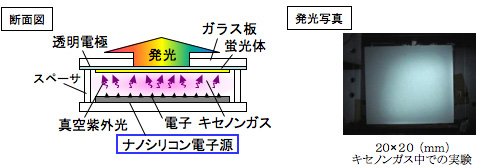
This is where Matsuda Denko comes in. They thought of a new way to make a light bulb. The basic idea can be seen in the picture below.


This new type of bulb (OK, so it's not a bulb but more of a sheet of light) is produced used something called a "nano-silicon battery." Well, this is an isn't a real battery. The nano (which just means really really small) silicon device can not actually store any energy, but it will release a lot of high energy electrons when a current is passed over it. The electrons be produced in a unit that contains xenon gas. Xenon gas is chemically inert and safe for humans. When the gas gets excited by the high energy electrons get excited like the mercury gas in the fluorescent bulbs. The xenon releases UV which hits a fluorescent substance. This gets excited and releases visible light.

I would like to see where this will end up going. It looks like the "bulbs" are actually strips of light. That means that we could light a room just by glueing (or otherwise attaching) strips to the tops of walls and other such places. Depending on the flexibility of the bulb (though I have no reason to think it will be flexible) it could be used in many interesting places.

Any way, it is now time for the word of the day. Today's word is 水銀(すいぎん). It is pronounced suigin and means mercury. I remember one year working in the physic department there was a minor mercury spill. The surface tension of mercury is so high that is naturally makes a ball when it is out of a container. It was fun chasing those small beads of mercury around.

That's it for today. See you next time at JJNN.

Friday, July 11, 2008

JJNN Friday: Technology - 01

Welcome again to JJNN for Friday July 11th, 2008. Today is technology day.

There is nothing more exciting for most Japanese people that the start of sales for a new piece of technology. It just so happens that today is the first day that the iPhone goes on sale in Japan. You can see some stories about it here and here.

I think that everyone that reads this probably knows what an iPhone is, but just in case I want to talk about that a little bit. The iPhone is a cell phone that went on sale in the states on June 29th of last year. Another version of the iPhone that is called iPhone 3G (3rd generation of cell phones) was released today in the states. That same cell phone is the one that went on sale in Japan and 19 other countries.

Let's get right to the price. A 8Gb iPhone will set you back 23040 yen while the 16Gb version will set you back 34560 yen. I guess all in all it is not a bad price. I mean it can be used to hold all your music and some other files. I don't see any real reason to get the 16Gb version unless you are into music. I guess all this talk of music makes it seem that the iPhone can only be used for music, but don't forget this is a phone (as well as an internet browser, a map, a contact list, a calendar and the like). The monthly fee for the basic plan for phone use is 7280 yen.

The phones started to go on sale at noon, but there were people waiting in line from at least 7 in the morning in places like Sapporo. In Yuraku-cho in Tokyo there was a countdown ceremony. A picture from the ceremony is below.


The lady on the right is named Ueto Aya. She is one of my favorite actresses. Maybe I will be getting myself an iPhone after all (I don't think I will really get one, but it looks nice).

Any way, it is now time for the word of the day. Today's word is 携帯(けいたい). It is pronounced keitai and means cell phone or anything else that you can carry around. The Japanese love to shorten words. The actually word for cell phone is keitai denwa, but everyone just calls it a keitai. I guess simple is best.

That's it for today. See you next time at JJNN.